Survival Library— The Best 100 PDFs That You can Download For Free

This list of free PDFs is a great resource not only during an extended disaster situation but also anywhere that medical help just isn’t 10 minutes away.

Did you know that during Hurricane Katrina and Sandy people went to local Libertarian preppers and volunteers for leadership and supplies? Download these free Ebooks and get started in a whole new realm of freedom and self-responsibility.

Guidelines are included not only for what to do but for when and how to seek help.

It’s that “what to do in the meantime” that makes it such an invaluable resource. Even if you’re just out for a daysail or a weekend in the woods, you may be an hour or more from help — and you may not even be able to call for advice via cell phone or radio.  Having these books downloaded on your laptop, tablet or smartphone means that you always have the information you need and can even save your life or anyone else’s that might need help.

If you find any broken links plese let me via email and I will fix them. Enjoy.

Where-There-is-No-Dentist-Murray-Dickson.pdf


https://docs.google.com/open?id=0B6GE42-kvADvZDk0NGM5Y2YtOTUwMS00ZWM3LTgxMWMtNjU5ZWQwNDk5ZjE4
Where-There-Is-No-Doctor.pdf
https://docs.google.com/open?id=0B6GE42-kvADvMjQ3Y2VkOTQtMzI3Zi00YjlhLWE1NWEtYWQ1OWY4ZDlhZmEz
survival-personal-wilderness-medical-kit.pdf
https://docs.google.com/open?id=0B6GE42-kvADvMGE0Nzk5ZjktOWU3MC00ZTkxLWIwZDgtNTk0Yzk0YzVmNzky
Wound Closure Manual
https://docs.google.com/open?id=0B6GE42-kvADvMmM2ZDA0Y2ItM2NiYS00YzVjLTgyYTAtYWExMmUzNjczZDc1
Full-First-Aid-Manual-FM-2111.pdf
https://docs.google.com/open?id=0B6GE42-kvADvYjM2MTVhNjQtMjYwNS00YmU2LTk5MTQtYjRmNWI3NDA4YTRl
Emergency War Surgery
https://docs.google.com/open?id=0B6GE42-kvADvNzk4M2ZmNWItMzM1Yi00NDNkLWI2MjItNDQxOGQyNTBlMTNm
Ditch-Medicine-Advanced-Field-Procedures-For-Emergencies-1993.pdf
https://docs.google.com/open?id=0B6GE42-kvADvZDQzNjBlNTItYmVkYS00NGU4LWJjYjYtMmNlNGQ2ZTM5ZDJk
USMC-Wilderness-Medicine-Course.pdf
https://docs.google.com/open?id=0B6GE42-kvADvZDhmYjA5YzQtOGRhNi00MDkyLTkxZWMtYWYwYjM1YjA3NTc4
————————————————–
Survival Manuals
Urban Preparation Kit, Part I, On-Body Kit
https://docs.google.com/open?id=0B6GE42-kvADvYzYyNTg4M2ItYzk4Zi00MzU2LWFlNjEtZmNiMjU4ZGE0MWVi
Traps.PDF
https://docs.google.com/open?id=0B6GE42-kvADvMTY3NmZhNGUtN2RmOS00MzA4LThiNTctOGU1MTllODM0Zjlh
Wilderness Survival Skills.doc
https://docs.google.com/open?id=0B6GE42-kvADvMjAwNmY0OTctNDA4ZS00ZjI2LWE0MjgtZjhiMTc5NzU1ODFi
Surviving-Terrorism.pdf
https://docs.google.com/open?id=0B6GE42-kvADvZDIzM2MxOWUtMDY5NS00OTE2LWFlNGYtOWJjMWQzMmEyMTlj
Survival-Wilderness-Survival.pdf
https://docs.google.com/open?id=0B6GE42-kvADvMGUyOTg4YjctYjM0OC00N2NiLTg0NTAtYWU2OGIzNjI2ZmRl
Survival-Water-Purification.pdf
https://docs.google.com/open?id=0B6GE42-kvADvODk1YThhZDUtNzEyNC00MDA4LThiNTAtZGY5NDQyNGI2M2Q2
PRESERVING GAME MEATS
https://docs.google.com/open?id=0B6GE42-kvADvMWIyMjUwOTEtMjgyZS00NGZiLTkyMDctNjY1ZjIxNGM3NGM5
Nuclear War Survival Skills
https://docs.google.com/open?id=0B6GE42-kvADvNDFhNTZhZTEtZTlkZS00M2Q1LTkwY2ItZGQ1NjFhYzc2ZDYx
How to build a debris hut
https://docs.google.com/open?id=0B6GE42-kvADvOWE3NWI5MTMtNWViMi00M2UyLWIxY2EtZGE0OTY4MjdkNTYy
HHS Pandemic Influenza Plan
https://docs.google.com/open?id=0B6GE42-kvADvZmVkYTM3MTQtOWVmMi00YWNjLWE2MjktYTQ0NDAxMzZlMWQ1
Combat-Survival-Evasion.pdf
https://docs.google.com/open?id=0B6GE42-kvADvOTk3OTlkNDgtODZkZi00NmQzLWFjMGItMGJmNTdjODYzOTdk
Cold_Weather_Survival_rev2.qxd
https://docs.google.com/open?id=0B6GE42-kvADvOWQyNjhhZTItMGMzYS00ZjgyLTliYzgtN2IxYjVlYWE3M2Vi
Cold Weather Survival
https://docs.google.com/open?id=0B6GE42-kvADvODM5ZjE1YTAtODkwNC00NTcxLTliNDAtMWRlZmU1MWNjZGJl
Camp Life in the Woods and the Tricks of Trapping and Trap Making
https://docs.google.com/open?id=0B6GE42-kvADvNWRlMjMzODAtN2ZhZS00MGZlLWI1MTgtODY4MTBiZDg2ZDhi
Alpine Living for SAR
https://docs.google.com/open?id=0B6GE42-kvADvMjZlODlhMDAtYTM3MS00OWFhLTg3ZWMtZWQ1YWQzNTZmYjU1
Aids to survival
https://docs.google.com/open?id=0B6GE42-kvADvYTUzYjdkYzQtMGRlYS00YmEzLWFhYzYtNTJiOTdhN2EwY2Yw
Adventurer-Woodstravel-Module.pdf
https://docs.google.com/open?id=0B6GE42-kvADvYjhjMDg5Y2YtMGQ4ZS00NjNjLWExYWItNTE4NmM1ZjNhNDZj
FM 21-76 US ARMY SURVIVAL MANUAL
https://docs.google.com/open?id=0B6GE42-kvADvZDYwZDcxZDktNDkyYi00YmU1LTlkODItNDcxYzViYjRlNjNk
Survival-In-ColdWeather-Areas
https://docs.google.com/open?id=0B6GE42-kvADvYjQ1MjJmODgtZjVmZS00YTQ4LTk4NGItM2JkZjAwMmYxZDVi
SURVIVAL-EVASION-AND-RECOVERY
https://docs.google.com/open?id=0B6GE42-kvADvMzIxZDhmM2MtYmUwNy00YjEzLThkNjEtMmQ3ZTBmNGFiYzc3
NEWER US ARMY FM-21-76-Survival-2002.pdf
https://docs.google.com/open?id=0B6GE42-kvADvZTY4YjZhMmMtOWNjYy00MDI5LWFhMTItYTkwYjkzZDcwNjE5
Marines-Individual-Terrorism-Survival
https://docs.google.com/open?id=0B6GE42-kvADvMjZiZThiNWQtOTdjOC00ZmMwLTk4YzAtMjY2ODFkNWMwYWQz
USMC-Winter-Survival-Course.pdf
https://docs.google.com/open?id=0B6GE42-kvADvOWM5OTBiMzgtNzE4Ny00ZTgzLTgzMmMtM2E5ZWY1YzVlZmQw
Wilderness-Evasion-a-Guide-to-Hiding-Out-and-Eluding-Pursuit-in-Remote-Areas
https://docs.google.com/open?id=0B6GE42-kvADvYTQ2MTljNDMtMDg0MS00YjMyLWFhZmQtYWNmZDFiNDIwMTJi
USMC-Summer-Survival-Course.pdf
https://docs.google.com/open?id=0B6GE42-kvADvMmIxZGVmMDMtYTRiZC00MjRiLTljNzgtYjA5YTNiMjk3Mzhh
————————————
Edible & Medicinal Plants
WHO-Monographs-on-Selected-Medicinal-Plants-Vol-3.pdf
https://docs.google.com/open?id=0B6GE42-kvADvODhhMTdkNGMtNjEyNy00NDNlLTg2M2MtMzA2ODhhYzNjNGFm
WHO-Monographs-on-Selected-Medicinal-Plants-Vol-2.pdf
https://docs.google.com/open?id=0B6GE42-kvADvOTk4MzRkYWYtZTNhNi00OTg0LThlMGYtN2IxYWVmODE5MzY3
WHO-Monographs-on-Selected-Medicinal-Plants.pdf
https://docs.google.com/open?id=0B6GE42-kvADvY2RjMDk3ODMtZDFjYi00YmM3LWFkOGMtMTgyODExMmJmYjk1
Useful-Wild-Plants-of-the-United-States-and-Canada.pdf
https://docs.google.com/open?id=0B6GE42-kvADvZjY2NTcyNzktOTIyMy00Y2Y1LTg4MzYtNzUyZGZhMWQ4MTI4
Survival Medicine
https://docs.google.com/open?id=0B6GE42-kvADvMThhN2YxMTctNDU4ZS00MGMzLTk2NzgtNmE5YzI5Yzk0ZTky
survival-how-to-make-herbal-preparations.pdf
https://docs.google.com/open?id=0B6GE42-kvADvZDVkMjQ4MGMtZmJlZC00OGE1LWFlYzItMmYyNjY5NjEwZDA4
Survival-Edible-Medicinal-Plants.pdf
https://docs.google.com/open?id=0B6GE42-kvADvMjkyY2MwMzQtMDk5ZC00ZjFjLTg1YzQtZjcyZjJmYzY0OTBm
MEDICINAL PLANTS in Folk Tradition
https://docs.google.com/open?id=0B6GE42-kvADvNGNmZGNlZmItMjA1MS00MmU4LWE4YjUtMWZhNjY0M2E3NDNj
Herbal-PDRsmall.pdf
https://docs.google.com/open?id=0B6GE42-kvADvZTRkZmE5NTctM2JiNC00NTExLTgxMWYtYWE0MDg0MzQyYTcz
Healing-Pets-With-Alternative-Medicine.pdf
https://docs.google.com/open?id=0B6GE42-kvADvNDc2M2Y3ZGMtOGVhZS00OTEwLWJkZDYtY2NjM2I1YTU5MDY0
Ethnobotany-of-the-Forest-Indians.pdf
https://docs.google.com/open?id=0B6GE42-kvADvODE2ODgyMjctMDU5OC00NGVkLWFlODEtNGE4NzQ0ZGViMzFl
Edible-Wild-Plants.pdf
https://docs.google.com/open?id=0B6GE42-kvADvMjJhNmM4ODEtNmU3Yy00OTJkLWFkMTAtZTU1NzQ2MmE4ZmI1
EDIBLE AND MEDICINAL PLANTS.doc
https://docs.google.com/open?id=0B6GE42-kvADvNmE4MDBmMzAtMDU3NC00NWZiLThhY2QtMmYwNWRmNjZkNWQ0
Dale-Pendell-Pharmako-Poeia.pdf
https://docs.google.com/open?id=0B6GE42-kvADvZjBhZWEzY2YtZTcxNS00Njc3LWIwMTctYjI4YjJmYWJlNGFl
Crow-Indian-Recipes-Herbal-Medicines.pdf
https://docs.google.com/open?id=0B6GE42-kvADvNDIxNjM2OTgtYzBmYS00ZjI3LWE4MTItODExM2ZkNTk1NmQ2
Common Edible Mushrooms
https://docs.google.com/open?id=0B6GE42-kvADvMDZjZTA1NjAtZTQ2Ni00OWU2LTk2NDItODVlOGY5NzM5YTU2
Anticancer-Therapeutics.pdf
https://docs.google.com/open?id=0B6GE42-kvADvODU0MTMwNGMtN2NhOS00ZjUyLWFlNjEtMmMwMzNmNmQwZmVj
A Complete Handbook of Nature Cure
https://docs.google.com/open?id=0B6GE42-kvADvYjEyOTQxM2EtZjBkMi00Njg1LWFjYWEtMmU5ODg0MjRhYzEz
WHO-Monographs-on-Selected-Medicinal-Plants-Volume-4.pdf
https://docs.google.com/open?id=0B6GE42-kvADvYzI0YzgyNGMtNGIzNS00MjlkLTg5MDAtNWVmZDY4NmU3MzM4
——————————————————
Knots
survival-knotes-and-how-to-tie-them.pdf
https://docs.google.com/open?id=0B6GE42-kvADvN2Q4YjExYWUtNDg1Yi00YjU1LWJhY2EtMDZjYTYwMDE1OWIw
sea scout knots
https://docs.google.com/open?id=0B6GE42-kvADvNmE3ODUxNTQtOTAyYi00YjE5LThiYTUtNjkxZTY4Mjk1ZmIz
Ropes-Knots-Ladders-Lashings-Anchorages.pdf
https://docs.google.com/open?id=0B6GE42-kvADvZjkyOTNlOTItNDUyMi00YjNhLWI3NjgtNzhmYzc0NjZlNzQy
knots splices attachments
https://docs.google.com/open?id=0B6GE42-kvADvZmUxMjUxZDUtODEyZC00OTk5LTlhYTktMDkwNmRiZmM1ZjY4
Knots, Splices and Rope Work
https://docs.google.com/open?id=0B6GE42-kvADvYjhiNzkxYjYtZDZlNy00NWIxLWIxMjMtMmJhNzM0ZDhkMTcx
Knots-for-Mountaineering-Camping-Climbing-Utility-Rescue-Etc
https://docs.google.com/open?id=0B6GE42-kvADvNjJhMTA4ZGQtYjk3MC00YTUxLWEwOGItMDAxMjYzMTE4NDI5
Knots-by-Andrew-Adamides.pdf
https://docs.google.com/open?id=0B6GE42-kvADvNTk2MDU0MzgtODE0My00ODVjLWJhMTgtOGMyMzhiOWFmZjk1
pioneering knots and lashings
https://docs.google.com/open?id=0B6GE42-kvADvOTBlNDExN2UtODM3Yy00YTg2LWI2NDEtYjFiNDViYjQ4OGQx
KNOTS
https://docs.google.com/open?id=0B6GE42-kvADvZGY3MDhkMzAtOGQxMC00M2I2LWE1NzItY2Y4NmFjZTFiMmIw
Handbook-of-Knots-Splices.pdf
https://docs.google.com/open?id=0B6GE42-kvADvNjZmMDY0NGItZThhZS00OTcyLWJlYTktMjIxYjg2ZDc2NTQ4
Fishing Knots Tying How To Tie A Knot Knotting
https://docs.google.com/open?id=0B6GE42-kvADvMzIzNGQ1MGEtMWQxYi00MWE2LWJiNGEtNTMzOWIwN2I2NDNi
Essential-Fishing-knots
https://docs.google.com/open?id=0B6GE42-kvADvMDMyMmNiMzctZGIyMC00Yjk5LThmMGUtOTRlOGRjNTBhODQ1
Encyclopedia-of-Knots
https://docs.google.com/open?id=0B6GE42-kvADvMzJiZmI2NTktMzM5Ni00MzU4LTg5M2ItMDJiMGI1MmRlNDk4
basic-book-of-knots-and-lashings.pdf
https://docs.google.com/open?id=0B6GE42-kvADvZDMzZTlmNjAtMjVmMS00NGNkLWI5YTEtMWM1ZTgxYTY3NGZk
What-Knot-Useful-Knots-for-Scouting-and-Climbing-Martin-Stone
https://docs.google.com/open?id=0B6GE42-kvADvMmI3MWM5MWQtNDI1Zi00YjJhLWEwODItZDRkNWNlZWQ0ZGY5
Tying-Farm-Knots.pdf
https://docs.google.com/open?id=0B6GE42-kvADvYzNmOGM5OTEtMTRmNy00MTc2LThiNDAtZmExYmE1YWMzMjZj
——————————————————–
military manuals
US-Marine-Corp-Pistol-Markmanship
https://docs.google.com/open?id=0B6GE42-kvADvYTRkYzY5NGEtOWRjOC00YzI2LWEzNTktMzgwOGE4YjBjZDJm
US-Army-How-to-Kill-Tanks.pdf
https://docs.google.com/open?id=0B6GE42-kvADvYTNiY2E0N2QtOWM0ZC00ZmM5LWE1MGMtNGQ5MDZhYzAwZjk0
US-Army-Combat-Training-w-Pistols-fm-323×35
https://docs.google.com/open?id=0B6GE42-kvADvMjc0N2U3ZDQtZDI3Ny00OWNhLWEyMzQtN2Y1NzdiMzc2ZmI1
United-States-Marine-Corps-Fmfrp-12185-April-1989Mao-Guerrila-Warfare
https://docs.google.com/open?id=0B6GE42-kvADvMzlmYzQ2M2UtZGQ0Zi00ZTUwLTk0YmItZDBjNzdjNWY3MWIz
US-Army-Map-Reading-and-Land-Navigation.pdf
https://docs.google.com/open?id=0B6GE42-kvADvNjVmYmEzOGQtYjNkZC00YjdmLTllMGMtOGNlYTEwNmY0YjVl
Topographic-Operations.pdf
https://docs.google.com/open?id=0B6GE42-kvADvYzU1Njc2ODgtMDA3Yi00OWE5LWE3Y2QtODU4NWU2NzA2ZTc0
Terrain-Analysis.pdf
https://docs.google.com/open?id=0B6GE42-kvADvMWZmOWRmMTQtMjE4ZC00ZjUyLWEzZWEtZWFkNTdjNjQ0MTA4
TC 31 – Special Forces Caching Techniques.doc
https://docs.google.com/open?id=0B6GE42-kvADvM2UyM2VjYTgtZDRjOC00MjczLWJlYjYtOGZkY2I4Y2Q0MTlh
Rifle-Marksmanship-Expanded-MCRP31a
https://docs.google.com/open?id=0B6GE42-kvADvNTkzMDgxOGUtNDA1ZS00MzU0LTkxNmQtYjEzZDE3MGRjMzc0
Rappelling-TC2124
https://docs.google.com/open?id=0B6GE42-kvADvNmFlMjg1ZmEtMzgzNi00NjZhLTk2N2ItY2Q3NmNlNTgzZDJj
Ranger-Unit-Operations-Fm785
https://docs.google.com/open?id=0B6GE42-kvADvZDEyZjJiMTMtNDA5OC00OWU2LWJmOTMtMzViZWIyZTEyMWY1
Canadian-National-Defense-Defence-Nationale.pdf
https://docs.google.com/open?id=0B6GE42-kvADvNjEzZTVhMDMtODk0MC00MWNjLWIzZjQtMzBjMWY0ODZhYWI2
Mountain-Operations-FM3976
https://docs.google.com/open?id=0B6GE42-kvADvYjA5MDc2NGMtODIyYy00ODc3LWJlYzUtYzlkZjY2ODljMjcy
Marine-Land-Navigation
https://docs.google.com/open?id=0B6GE42-kvADvODcwZWUzYTQtZWJiNS00Y2Q3LTg4ZjMtOTVhMWY1YTNjNTI2
How-to-Start-and-Train-a-Militia-Unit-PM-94-1.pdf
https://docs.google.com/open?id=0B6GE42-kvADvMDc5NjNlZTItMDgxYi00MzMxLTlhZDgtNjhlYjI2OTg4YjI0
How-to-Find-Your-Way
https://docs.google.com/open?id=0B6GE42-kvADvZWE4M2NjN2EtYjJkMC00YTUyLWE4M2UtZTNiOGFlNzc1Njc1
Combat-Survival-Guerrila-Skills-Handbook-of-the-Red-Chinese.pdf
https://docs.google.com/open?id=0B6GE42-kvADvNTRiYTE0YTQtY2Q0ZC00MDFmLTgzMGUtMGZkOTA1MzFlNTQ3
Combat-Skills-of-the-Soldier-fm2175.pdf
https://docs.google.com/open?id=0B6GE42-kvADvZDVlMTZmN2YtMGU2Yy00YjAzLWI3N2EtNzQ4MTA1YWJkOGIw
Combat-Guerrila-Survival-Skills-The-Bear-Went-Over-the-Mountain
https://docs.google.com/open?id=0B6GE42-kvADvZjE3YjU5MmMtY2YxZS00ODAxLTliN2MtMTZjZGUxNzQ5NDg5
US Army Field Manual FM 3-19.15, Civil Disturbance Operations
https://docs.google.com/open?id=0B6GE42-kvADvZjgxYzczNzYtMDkxNC00OGEyLTk3MTUtMjgwNjIzYTllODIy
Canadian-Military-FieldCraft
https://docs.google.com/open?id=0B6GE42-kvADvYWZiYzhmOWEtODUxZS00ZmM5LWE2ZDctOWU4MWE3OThlYTQ0
basic-food-preparation
https://docs.google.com/open?id=0B6GE42-kvADvYTAzNTI1YzUtZGNkZC00ZjQ3LWI4NDUtMTUxOGViMTQ5MGY4
Army-stp21-24-Soldiers-Manual-of-Common-Tasks-Warrior-Skills-Level-2-3-and-4
https://docs.google.com/open?id=0B6GE42-kvADvNTMyOThmYTYtMTUxOC00Y2U1LTk3NGItZmY5NTE1MjU2MzJh
Army-stp21-1-Soldiers-Manual-of-Common-Tasks-Warrior-Skills-Level-1
https://docs.google.com/open?id=0B6GE42-kvADvMTZiOGFmOGYtMzdiNC00NTA1LTk2MzgtMjExNmMyYzQ4MDM2
Army-fm31-70-Basic-Cold-Weather-Manual
https://docs.google.com/open?id=0B6GE42-kvADvNGU4ODU0ZGQtMzNjNi00Mjk3LTljNTMtOWFjYzA0OTkzNzgz
Army-fm20-3-Camouflage-Concealment-and-Decoys
https://docs.google.com/open?id=0B6GE42-kvADvMGRhYjQ3MzEtZDBjYi00YWYxLWE1YWUtM2FkMTBjYjQ2YzRj
Army-fm5-428-Concrete-and-Masonry
https://docs.google.com/open?id=0B6GE42-kvADvMDczYTY3YmUtNWY4ZC00ZTJiLTk2Y2QtMjBmNWZiZjU4OWI3
Army-fm5-426-Carpentry.pdf
https://docs.google.com/open?id=0B6GE42-kvADvMDM0ZDA4YzEtM2I0My00NjlhLWE1YTItMjdlYmNjN2YwZjc1
Army-fm5-103-Survivability
https://docs.google.com/open?id=0B6GE42-kvADvYWMxYWI1ZjQtNDc3MS00OTA0LThiNzUtNmQxN2JjZmQxODAz
Army-fm3-06-Urban-Operations.pdf
https://docs.google.com/open?id=0B6GE42-kvADvN2UwOTQwYWQtNTYwZi00ZjVlLWE5MmMtODAyOTdhYTIyODRl
Arctic-SubArctic-SurvivalB-GL-323-003-FP-001.pdf
https://docs.google.com/open?id=0B6GE42-kvADvNDYwN2Q2OTYtZjViMy00YTZkLTg1MjAtYjZjMmE0ODExMTVl
USMC-MCRP-301A-Rifle-Marksmanship
https://docs.google.com/open?id=0B6GE42-kvADvOGI3MDI3ZGItMTExNC00MTU3LTlhOWItNmI1YzVlODk2ZmY2
———————————-
NEWLY ADDED BOOKS
How to & Bushcraft books
US-Marines-Close-Quarters-Combat-Manual-FMFM-07.pdf
https://docs.google.com/open?id=0B6Swa8Pwy-0KZDgzNjNmOWUtM2I2Zi00NWZmLWI3NmMtNzFkZDVmZjYwNWU2
US-Marine-Corps-Hand-to-Hand-Combat.pdf
https://docs.google.com/open?id=0B6Swa8Pwy-0KZmE5MWI5ZjMtNmZmYy00ZmIxLWFlNjUtY2RlNmJhNjQ3ZTYz
US-Army-Combatives-handtohand-combat-FM-325-150
https://docs.google.com/open?id=0B6Swa8Pwy-0KYWE1Mzg0NDUtZmJiNS00NTEwLWJjZjAtMWRkODg1MjZhNDlh
Pressure-Points-Military-Hand-to-Hand-Combat-Guide
https://docs.google.com/open?id=0B6Swa8Pwy-0KOWU0ZDA1YmEtMzYwYi00NzJhLThmNTUtNzM4ODJjYTdhZDIx
Practical-Unarmed-Combat-by-Moshe-Feldenkrais.pdf
https://docs.google.com/open?id=0B6Swa8Pwy-0KMWY2ZDc4MmYtZDk5MC00YmM3LTgyODUtYTRmMWJjNWI1YjQ1
Navy-Seal-Physical-Fitness-Guide.pdf
https://docs.google.com/open?id=0B6Swa8Pwy-0KMGI5YjAyM2UtNDhhOS00ODNhLWJjZWUtYTIxYjkxN2MyZTEz
Marine-Martial-Arts-Training-
https://docs.google.com/open?id=0B6Swa8Pwy-0KNzFmMjIzMDEtMDIyNi00NTBhLTk3NDMtOGYwODIxMDRlYmUy
Krav-Maga-Pressure-Points-Military-Hand-to-Hand-Combat-Guide
https://docs.google.com/open?id=0B6Swa8Pwy-0KZmRiNGZlMjEtOTI3ZC00MTM1LWE5ZWItN2UzMDA3YTkzODA2
( Hand to Hand: Martial Arts ) Aikido ( revised )
https://docs.google.com/open?id=0B6Swa8Pwy-0KMzUxYjhmNWUtOTAxOC00OWVlLWJmMjMtMzRjZWJjOGZiM2Rh
Get-Tough
https://docs.google.com/open?id=0B6Swa8Pwy-0KNjdmOWMzMGMtYWU4Mi00NWIwLThmZGItZTg5ZTEyYjYzOTVk
Combat-Conditioning-Manual-JiuJitsu-Lt-Col-RE-Hanley-USMC.pdf
https://docs.google.com/open?id=0B6Swa8Pwy-0KNGVjOTdjYTctNzNkYi00ZTdlLWE3OGUtZTVlMzNiNDllYWYy
USMC-Kill-or-Get-Killed
https://docs.google.com/open?id=0B6Swa8Pwy-0KM2Q2ZWQ3YmQtMzZhYS00ZWVhLTliYTItNDBiMGY2MzYxNzNm
1999_Dutch_Oven_Cookbook.pdf
https://docs.google.com/open?id=0B6Swa8Pwy-0KYWRkNDgyNjYtZmU1NS00NGRhLTkyZjEtNmY0ODdkZDk4OWU4
bushcraft leather work PDF
https://docs.google.com/open?id=0B6Swa8Pwy-0KZjdmNDhkNDMtNTI4MC00ZWM3LWE5MTMtZGE3MzkyNmFmMjg2
boyscout cookbook PDF
https://docs.google.com/open?id=0B6Swa8Pwy-0KMjMwMmJhNTUtYTYzZC00MzA3LWE3MTYtMWNmZWQ4ZjZlNGU3
The Back Country Recipe Book
https://docs.google.com/open?id=0B6Swa8Pwy-0KOTE3M2U0ZDYtZmQ3NC00NWI4LThiZWItMjZhMzU0MzRiZWY2
Australian Bushcraft PDF
https://docs.google.com/open?id=0B6Swa8Pwy-0KN2Q5N2I0NTQtZjE1OS00ZTRiLWIxNDAtMzkxMzU0ODYwMmRk
Flintknapping PDF book
https://docs.google.com/open?id=0B6Swa8Pwy-0KNTc3MTcxMzQtZjQ0MS00ODc2LWEzNDUtMzlmMWI5ZDM1NDMy
The-Ten-Bushcraft-Books.pdf
https://docs.google.com/open?id=0B6Swa8Pwy-0KMDQyMDNhOTctODQ2NC00NDFlLTg4MDYtOTE3NDE0ZDk5NTQz
The-Book-of-Camplore-and-Woodcraft-Dan-Beard.pdf
https://docs.google.com/open?id=0B6Swa8Pwy-0KYTFlZjA5MjEtYTU1OS00ZTMwLWI2Y2UtOTNhM2EyMGY2Mjcz
Shelters-Shacks-Shanties-Daniel-Carter-Beard
https://docs.google.com/open?id=0B6Swa8Pwy-0KZmI0YjA2YzUtZmViNS00YzVmLThkMzktNmJlMzk1YTFiZTc1
Foxfire-One.pdf
https://docs.google.com/open?id=0B6Swa8Pwy-0KODJlMTU3MTItY2MxNS00MTZiLWEyODEtMTU5YWQwZjZmZDFi
Foxfire-Two.pdf
https://docs.google.com/open?id=0B6Swa8Pwy-0KOTU2MjI3NTAtYTNjYS00ZDZhLWI0ZDMtZDNjNjMwMzRiNDM1
Foxfire-Three.pdf
https://docs.google.com/open?id=0B6Swa8Pwy-0KNzJjOWYxMDUtNjg1ZC00YzRmLWE0NTItYmMzMThhMjlhZmM2
Foxfire # 4 & 5 are on the blocked list
Bushcraft-Scouting-Woodlore-Notes.pdf
https://docs.google.com/open?id=0B6Swa8Pwy-0KMGMyNjFhMDgtMzlkNC00NDNlLWJiZmMtZGU2ODhkODY0MjZl
Woodsman-Ship.pdf
https://docs.google.com/open?id=0B6Swa8Pwy-0KOGI2MzA1NTAtMGViMC00ODA0LWFlNTgtOTNjODdmNTg4YTNk
Vegetable-Garden-Encyclopedia.pdf
https://docs.google.com/open?id=0B6Swa8Pwy-0KYjY5MzA0MzctM2UxOS00YmQwLTliNWMtNGFlYzIwYmZmNzQw
Guide 5, Preparing and Canning Poultry, Red Meats, and Seafood
https://docs.google.com/open?id=0B6Swa8Pwy-0KN2IzZjRmNjAtZmU5Mi00M2NiLWE3ZTktYTE3NzQyY2Y5NTQ1
The-Unofficial-MacGyver-HowTo-Handbook-Revised-2nd-Edition.pdf
https://docs.google.com/open?id=0B6Swa8Pwy-0KMzZhYTE0OTMtNTdjNy00ZWNkLWI2MzQtNDIwMDJhZWZkYTMz
The New Complete Book of Food
https://docs.google.com/open?id=0B6Swa8Pwy-0KMDFmZTIzMzctNWQwYi00NjczLThkYWUtYTE4MTVmY2QxMWE3
The-Making-of-Leather-by-Procter-Makingofleather00procrich.pdf
https://docs.google.com/open?id=0B6Swa8Pwy-0KOTEzODI4MjktYzg0ZC00Zjg3LTk1NjctMzUyZTM2OTQzYjRi
The Jerky Chef
https://docs.google.com/open?id=0B6Swa8Pwy-0KOTJlNjM5ZDItY2ZlOS00ZmY0LTlkOTYtNDIxYTA0YzUzNjc0
The complete guide to home carpentry
https://docs.google.com/open?id=0B6Swa8Pwy-0KZmUzNzJmZWYtZTEyZC00YmNhLWI3YjEtZjEyN2VmMTMyMTIw
The Back Country Recipe Book
https://docs.google.com/open?id=0B6Swa8Pwy-0KMzU4ZjgxMGMtNDJhMy00NzViLTgyOWQtYTliZGYxZDE0NDg2
The-Baby-Food.pdf
https://docs.google.com/open?id=0B6Swa8Pwy-0KZDNhMmExZmUtNmI3YS00YjBiLWIyNTktOWRhMGExZmYzNTU0
The Journals of Lewis and Clark by Meriwether Lewis.pdf
https://docs.google.com/open?id=0B6Swa8Pwy-0KYjk3N2Y2OTQtMGM4My00MDA2LWE3ZjEtMTExNTkzZjAzY2Y5
Tecumseh-Service-Manual
https://docs.google.com/open?id=0B6Swa8Pwy-0KZDNjZjBjZGQtYzFiZi00OWViLWEzODYtOGQ3Njc0MzkyMjc2
Steal-This-Book
https://docs.google.com/open?id=0B6Swa8Pwy-0KMTcyMjQ0NzgtNWQ5YS00YzEzLThmZWUtZTQ0Mjk5YzRmZGIy
Solar Dehydrator.PDF
https://docs.google.com/open?id=0B6Swa8Pwy-0KOThkZTU4NjctMTJhMi00NGE3LTlmN2QtYmZlYzQ4YTkwZTkw
SmallScale-Food-Drying-Technologies
https://docs.google.com/open?id=0B6Swa8Pwy-0KYzRiYjRhYzUtMTcyMC00NTI5LWJlOWUtZTk5MDcwYmQwNzlm
Secret-Hiding-Places.pdf
https://docs.google.com/open?id=0B6Swa8Pwy-0KOTMwN2EyNTQtNTAyZC00YTNiLWFkYzUtODg2ZWQyMjUwNThi
Radio-Monitoring-a-How-to-Guide.pdf
https://docs.google.com/open?id=0B6Swa8Pwy-0KZDU5NWNiMGUtZTUxYy00OTI2LWEyMTAtOWFjYTk4OWQxM2Nm
Preserving-Food-Drying-Fruits-And-Vegetables-
https://docs.google.com/open?id=0B6Swa8Pwy-0KNzNkNzU0NzAtZWU3NC00NTVlLThhNTMtYTcxYjIzMDA2MTli
Guide 6, Preparing and Canning Fermented Foods and Pickled Veg
https://docs.google.com/open?id=0B6Swa8Pwy-0KODViZmYwZDEtOWE0OC00ZGJjLTgxZTItODMyMzllNGYwMzk4
Practical Guide to Free Energy DEVICES
https://docs.google.com/open?id=0B6Swa8Pwy-0KNzlmZmFhZGEtOWZkYy00NDJlLWI5ZDktM2JlYjhmOGQwMmE5
Native-Berry-Recipes
https://docs.google.com/open?id=0B6Swa8Pwy-0KMmM5OTk4NzQtYzY4OC00OTFlLWJhOGYtOThmMDEwMzk2M2Mz
Metal-Forming(2).pdf
https://docs.google.com/open?id=0B6Swa8Pwy-0KY2YzNDNhOTUtMDYzMC00OGUwLTlkNTEtNTdhZTliZWJhZWRm
Read more here: http://libertariansmile.wordpress.com/2012/01/21/100-free-survival-1st-aid-military-tips-etc-books/


For All Intents And Purposes, There Are Only Two In Competition In The US And Those Are The AK-47 And The AR-15: Which Rifle is Better When SHTF?

Yes, I am going there. One of the most hotly debated questions in prepper/survival/firearm enthusiast circles is around the best survival rifle. For all intents and purposes, there are only two in competition in the US and those are the AK-47 and the AR-15. I will add that there are variants of both and I am lumping all of those into these two categories. This question of what is the best survival rifle is one that I asked myself when I was considering my first rifle purchase so I wanted to take some time to hash out what I see are the differences and to give you my opinion as to which rifle is better when it comes to the AK-47 vs AR-15.

House cleaning

I know that this subject is insanely controversial, even though it shouldn’t be. It’s the same as getting upset over Ford versus Chevy. If this post makes it to some of the firearms forums out there I know I will have some people who will disparagingly call me an “Internet Expert” implying that I have no idea what I am talking about. So be it. I am not an expert, but I don’t think anyone else is an expert either in this subject. I don’t think anyone out there is more qualified to determine what rifle is best in my opinion, for me, than me. I don’t really care if you are active duty police, 20 year military veteran, or mercenary for hire. This is my opinion based upon my belief and requirements, you are entitled to yours, but that doesn’t mean mine is invalid. It also doesn’t mean you are smarter than anyone else that disagrees with you. It simply means we have different opinions.

Additionally, I will throw out some facts that should be pretty easy to agree on and some opinions based upon my personal experience which may not be. Just because your experience is different, that doesn’t make it a law of science or anything. If you have a different experience, by all means, please comment down below but I would ask you to keep the debate civil as that is what I am going to try to do. If you would like to make your case for the opposite of what I recommend, please do so in the comments and we can all judge whether what you are saying makes sense.

History

sovietinlinearmy ak47

Very briefly, the The AK-47 is a selective-fire, gas-operated rifle that fires 7.62×39mm ammunition. The AK-47 was developed in the Soviet Union by Mikhail Kalashnikov. Design work on the AK-47 began in the last year of World War II (1945). In 1949, the AK-47 was officially accepted by the Soviet Armed Forces and used by the majority of the member states of the Warsaw Pact. It is still widely used today.

If you are going to count on a rifle, you should know how to take care of it.

The AR-15 is a lightweight, magazine-fed, air cooled rifle with a rotating-lock bolt, actuated by direct impingement gas operation or long/short stroke piston operation that fires 5.56 mm/.223-caliber ammunition.

The AR-15 was first built by ArmaLite as a small arms rifle for the United States armed forces. Because of financial problems, ArmaLite sold the AR-15 design to Colt who made some modifications and the redesigned rifle was subsequently adopted as the M16 rifle which was the main rifle used by US Armed Forces. Colt then started selling the semi-automatic version of the M16 rifle as the Colt AR-15 for civilian sales in 1963 and the term AR-15 has been used to refer to semiautomatic-only versions of the rifle since then.

For the purpose of this comparison we are only going to be discussing semi-automatic weapons available for purchase in the US by a non FFL carrying person, not their fully automatic counterparts.

The Facts

You can quickly see some of the facts below about each rifle on this excellent info graphic from TacticalGear.com , but I will list what I see are the important differences between the two rifles.

  • The AR-15 can effectively shoot 200 yards further than the AK-47.
  • The AK-47 shoots a significantly larger bullet than the AR-15.
  • The AR-15 weighs 2 pounds less (not counting a lot of hardware we add after the fact) than the AK-47
  • The AK-47 usually costs less than an AR-15.
  • The AR-15 has a higher (30% more) accuracy than the AK-47
  • The AK-47 is more widely used globally by a long shot than the AR-15.

The Debate

There are really only 3 main arguments that proponents of the AK-47 use as their rationale for saying that the AK-47 is the better survival rifle so I want to list and address each below.

  • AK-47 rounds penetrate better and do more damage – This is true generally speaking, let’s move on to the next point.
  • AK-47 Costs less – This is true generally, let’s move on to the next point.
  • AK-47 will keep working no matter how dirty it gets – This is also true to an extent, but with a caveat. The point to this argument is that if the AR-15 gets too dirty, you will have firing problems. I can tell you from personal experience that I have never had a single problem with any AR-15 or it’s fully automatic cousins that I have ever shot. However, I clean my rifles usually after every time I shoot them. Sometimes, I will wait, but they never go too long without a thorough cleaning, so what is this point supposed to be saying to us? Well, what if you are in a firefight and you have to shoot 300 rounds through your AR-15 rifle; will it jam then? No, at least not in my experience. Maybe if you shot 10000 rounds through it without cleaning the rifle you could see some issues, but if you are in a firefight so bad that you have shot 10000 rounds, you have bigger problems. What if you drop it in a vat of guacamole? Not a valid point in my book.

For more information and my opinion on which rifle is best, please read below the graphic.

AK-47 vs. AR-15

Which Rifle is the Best Survival Rifle?

I will tell you that in my opinion, the best rifle is the one you have with you when you need it. That sounds well and good, but if I was going to buy one rifle, and I lived in America, it would be the AR-15. Why? For me this comes down to 4 simple points.

Accuracy – The AR is simply more accurate at further distances than the AK-47. If I wanted to shoot a rifle up in the air when I was mad, riding in the back of a Toyota truck with 20 of my friends, or happy, or just plain stupid then I might get an AK-47. One of my goals is to be able to engage targets at up to 500 yards and the AR-15 does that better than the AK-47. The AK might use a heavier round that will go through more solid objects, but if you are able to kill the person holding the AK 200 yards before he can hit you, does that matter?

Range – Speaking of range, the AR-15 shoots further effectively, so that just adds to what I was saying above. Range is also important to me because I want to be able to take people out as far away as possible. I don’t want you getting so close that your AK-47 can hit me. I would rather you and your AK be far away and I will take care of you way out there. I don’t mind walking out there to pick up your rifle when I am finished.

Parts – The AR-15 is like the Barbie doll of the firearm world. There are so many accessories! And yes, the military version of this rifle (M16/M4) has a majority of parts that are fully compatible with the AR-15. The AR-15 is also the same weapon used by police, DHS, and NASA. If anything bad happens, there should be plenty of opportunity for spare parts to be acquired. I can’t say the same for the AK-47 unless we are invaded by Russia. So, even if your AK is able to fire with some mud in it, what if something breaks? That is why you buy spare parts you say. No, that is why you buy what everyone else is using including our government.

Ammo – Same as above, this is the ammo our police and military use as well as quite a large number of my countrymen, so I have the advantage of a very common caliber in my favor.

OK, that is my rationale and those are my reasons. The AR-15 does cost a little more on average, but you can find really good deals out there if you look and the price difference would be much lower. Does this mean I wouldn’t own an AK-47? No, not at all. I would love to have one, but I do think that for the reasons I listed above, if you can only choose one and you live in the good old US of A, the AR-15 is the better option in my opinion. I know for a fact people will disagree with me, so please let me know what you think in the comments below.

Do You Know These 25 Native American Survival Skills?

Native American survival skills included crafting their own survival tools and building their own shelters. They foraged for their food and hunted their prey, all by hand. It is astounding to think how well they survived and thrived based on necessity alone. Would someone like you or me be able to do the same if we were put into such a hostile environment? Probably not, and that it is why it is good to be aware of old-school Native American survival techniques. How did the Native Americans survive? How were they so deftly able to sustain themselves in the unforgiving North American wilderness?

It is very easy to forget, in our modern times of the Internet and instant heat, cooling, food, and shelter, that people use to live a much simpler and much harder life before the advents of these modern comforts. The Native Americans are the prime example of how people use to live off the land and survived the threats of nature with basic and cultivated survival tactics.

In this video, i will unearth a long-forgotten secret that helped our ancestors survive famines, wars, economic crisis, diseases, droughts and anything else life trew at them.
So pay chose attention because this video will change your life forever for the good!

Native American Survival Skills We Can All Learn From

This list will highlight 25 of some of the more interesting Native American survival skills commonly used by the tribes of North America. Let this list be an insight into the lives of these fascinating people, an educational tool for our modern culture, a means of appreciating a society that is so rare and thin today and a reminder that the human spirit and will are much stronger than what we give them credit for.

25. Community

The tribal mindset and lifestyle of the Native Americans of yesteryear play a huge role in their survival tactics. As you probably are already aware, Native Americans distinguished themselves by tribes. You have probably already heard of the more common and prominent tribes like the Apache, Navajo, and Mohican. The sense of community, sharing of resources and wisdom and collective protection between tribesmen cannot be understated when considering how Native Americans were able to survive.

24. Footwear

If you have ever worked a day in your life wearing the improper pair of shoes then you know how important footwear is to comfort and bodily health. Footwear was integral to Native American survival and moccasins made of tanned leather and sewn together were common in North American tribes. Although designs and cuts differed from tribe to tribe, features like rabbit pelt for added warmth and hardened rawhide for increased durability were common attributes of moccasins.(21 wild edibles you can find in urban areas)

23. The Fox Walk

The fox walk was a method of tracking, traversing and hunting stealthily for Native Americans. This specific style consisting of wearing thin moccasins to feel the ground better, landing on the heel first and rolling your foot down, and traveling in lines to conceal your numbers was used in battle and in hunting.

22. Preserving Meat

Meat got many Native American tribes through harsh winters, but there were no chemical preservatives or refrigerators back then. Instead, Native Americans would preserve meat by cutting it into lean strips, eliminating fat, and drying it in the sun. This is essentially what we know today as beef jerky. This thin, dried meat can keep for a very long time and was an essential food supply for Native Americans. We put together a guide to preserving meat in the wilderness.

21. Animal Hides

Animal hides were essential to Native American life and key to their survival. By honing a process of tanning and smoking, Native Americans were able to turn raw animal hides into moccasins, clothing, and even shelter.

20. Natural Observation

Being able to tell what kind of weather was on the horizon was a huge asset for Native Americans. They used the natural signs of the environment to predict weather and to prepare accordingly. They would study the behaviors of animals who have much keener senses for weather than we do and read the clouds. Here are 23 survival uses for honey that you didn’t know about.

19. Using Plants

How Native Americans were able to discern the healing powers of certain plants is an unknown but we do know that these practices were handed down from generation to generation so it was probably a case of trial and error. They would use plants, herbs, and other life found in nature to heal wounds and treat illnesses.

18. Artful Crafting

Native American skills and crafts work with materials from their environment. By turning the crafting of basic survival tools and shelters into works of art, Native Americans were able to make the essentials of life that would stand up to the rigors of their environment. Native Americans took their time to craft tools and shelters thus ensuring their durability and overall quality and helping them survive in harsh conditions.

17. Body Paint

Before hunts, Native American tribes would paint their bodies so that they could blend into the natural scenery, as stealth was a very important aspect of survival in those times.

16. Clothing

Proper clothing is essential for anyone to survive in any situation, and the Native Americans had their clothing crafting skills down to a science. They used animal hides and smoked leather to create warm clothing for the cold winters. They also used certain colored clothing for stealth when hunting prey.

15. Camps

The Native Americans often built temporary camps for hunting excursions but they still needed to maintain a certain level of stealth. They would build these camps with earth-toned materials and animal skins and tuck them into the base of foothills or other strategic natural sites so that they would be hard to spot from a distance.

Preparedness Hacks: Once a nuke is heading your way, you might think that there isn’t much left to do, but you would be wrong!

Because we will show you America’s natural nuclear bunkers that are also EMP proof. When the sirens start wailing, all you need to do is pick the closest one to your home, where you can take cover before it hits.

14. Blow Guns

These have become something of a novelty in today’s day and age but blow guns were actually used for hunting and in warfare by Native American tribes such as the Cherokee. They would fashion these weapons out of cane or reed. The reed would be hollowed out to a tube wherein a dart would be inserted and propelled by a strong breath towards a target. Blowguns were used primarily to kill small game like birds, rabbits, and squirrels and were sometimes tipped with poison extracted from venomous snakes and even Gila Monsters.

13. Deadfalls

Deadfalls are a kind of trap that was used by Native Americans to kill their prey. A heavy rock or log would be elevated by rope or a lever made of wood over a piece of meat or food to entice an animal. The deadfalls usually had a trigger that when the animal touched it, would activate the primitive trap and send the heavy object crashing down on them.

12. Snares

Trapping was one of the main ways that Native Americans caught their food and snares were among the most common types of traps utilized. A snare uses a vine that is tied in a loop and attached to a young sapling that is bent over and is fastened by tying it to a stick driven into the ground. The loop goes around a piece of meat to entice an animal and when the animal puts its head through the loop and tries to make off with the bait, the stick is dislodges and the loop turns into a noose around the prey’s neck and is suspended in the air as the sapling, free of its fastener, springs back into an upright position.

11. Trapping Pits

This is one of the more straightforward survival tactics utilized by the Native Americans. As the name suggests, this trap is simply a dug pit sometimes fitted with spikes at the bottom to kill or bleed the trapped animal. The dug pit would be covered up by branches and earth so that unsuspecting animals would walk over it and fall in.

10. Fishing Weirs

Fish is an indispensable food for Native Americans and among the ways that they would catch fish were fishing weirs. Fishing weirs are essential traps built by rock or wood that would lead fish migrating up or downstream to a corridor built to be narrow, ultimately trapping the fish.

9. Spearfishing

Another way the Native Americans caught fish was by spearfishing. There were different methods of spearfishing employed depending on the time of year. In the winter when the lakes would freeze over, a hole was cut into the ice and a lure made of bone was used to entice the fish toward the hole. Then, a spear made of wood for the shaft and copper or bone for the tip punctured the fish.

8. Hunting Tactics

It may seem simple now that we look back but many hunting tactics devised by Native Americans were learned over the generations and used to help them survive. Simple tactics like reading the wind and standing downwind from a target increased the chances for success of a hunt dramatically.

7. Nomadic Practices

Not all Native American tribes stayed in one place. After the Spanish visitors brought horses to the great plains, many tribes such as the Blackfeet, Crow, and Comanche adopted a nomadic lifestyle in order to hunt buffalo across the plains all year round. This supplied for them a stable food source and ensured, to a certain degree, survival.

6. Teepees

Of course, there can be no survival without some form of shelter. The Great Plains Native Americans knew this very well and built teepees which are essentially tents. They were commonly made from buffalo hides and long wooden poles.

5. Dedicated Tribe Roles

A lost every aspect of Native American life was spurred by survival. This is even true of the gender roles of the Native Americans. The men were the hunters and to prevent any waste which could mean the difference between life and death in the North American frontier, the women were the cooks. They would prepare the meat that the men brought back immediately so as not to waste a single morsel and ensure that they had plenty of food.

4. Bows

An indelible image that most people have of Native Americans is the bow and arrow which was vital for the survival of all tribes in North and South America. Most bows were fashioned out of wood and strengthened with animal tendons. Bowstrings were made from animal tendon or yucca and similar natural fibers.

3. Axes

There are certain tools that are as essential now as they were in the days of the Native Americans for survival. Among them is an ax. While Native Americans used axes for warfare, they were also used to chop wood that would be used for many different causes and to hunt prey.

2. Water

This may seem a simple and almost thoughtless aspect of survival but the fact of the matter is that if the Native Americans did not have sources of fresh water to draw from, they would have never survived. The plentiful rivers and lakes of the Americas helped sustain the Natives and they regarded water sources with great reverence.

1. Fire

There is no life without food and warmth and fire is number one on the list of 25 essential survival skills that kept Native Americans alive because it provided both. There were many methods of building fires among Native Americans but among the most common were striking stones like pyrites together to create a spark that would be caught be a pile of tinder. The friction caused by rubbing two sticks together also generated enough heat to combust tinder. Bow drills and fire pump drills were also common methods of starting fires. These contraptions used string wrapped around a stick and controlled by a bow to generate the heat needed to start a flame.

Check out this cool video from Tim Jones for some Native American fish trap idea:

Though the methods and practices of Native Americans varied from tribe to tribe, the innovation for the sake of survival was universal. They borrowed methods from each other and created ones unique to their tribe. They even borrowed from foreign settlers and visitors. The Native Americans were a group of humans that had to learn how to adapt and we are all the richer and wiser for their survival efforts. It is hard to separate the survival tactics we employ today from those introduced to us by the Native Americans. Thus, we owe a debt of gratitude to these people who learned how to tame the wild Americas and make them a place hospitable for human life.

Solar energy is a renewable source of energy with has many benefits.

The best thing is that you’ll save money on you electric bill.

To build your own solar panel almost for free, you’ll need to watch this video

Have you tried any of these Native Americal survival skills in real life? Share your thoughts about them with us in the comments section below!

Root Cellars 101- Root Cellar Design, Use and Mistakes to Avoid

In this article we’ll talk about 5 things you must include in a root cellar design, plus 10 tips for fruit and vegetable storage. There’s also a printable storage guide for over 30 fruits and veggies, and jump links to additional information at the bottom of the post.

A root cellar is a great low-cost way to store food – not just root vegetables, but other fresh produce, too. They require no energy to use and very little maintenance. You can build in a root cellar when your home is under construction, but it’s also possible to add a root cellar to your basement, or build one outside your home.

(21 wild edibles you can find in urban areas)

What is a root cellar?

Dig a deep enough hole, and you’ll find that the ground is cool (and often moist). Root cellars tap into those cool, moist soil conditions and use them to store produce – like your refrigerator produce bin.

Preparedness Hacks: Once a nuke is heading your way, you might think that there isn’t much left to do, but you would be wrong!

Because we will show you America’s natural nuclear bunkers that are also EMP proof. When the sirens start wailing, all you need to do is pick the closest one to your home, where you can take cover before it hits.

Building a Root Cellar

There are five major elements that a root cellar requires:

  1. Ventilation:  Some produce gives off ethylene gas, which can cause other produce to spoil. Also, a tightly sealed cellar will increase the risk of mold. Make sure fresh air can get in, stale air can get out, and air can circulate around the produce.
  2. Earth-shelter:  The soil insulates and maintains a cool temperature. A packed earth floor or gravel floor is better than concrete for keeping moisture levels high.
  3. Darkness:  Light can trigger sprouting, so if you have a window in your root cellar, keep it covered, and don’t leave the lights on.
  4. Humidity:  A high humidity level of 85-95% keeps produce from drying out. Note: Humidity that is high enough for produce may cause canning jar lids to rust, so be sure to check lids and rotate stock if you store canned goods in the root cellar.
  5. Shelving/Storage bins: Wood shelving and bins are naturally antibacterial. Wood also conducts heat more slowly than metal, and doesn’t rust. Avoid treated wood, and stick to those that are naturally rot resistant.

Types of Root Cellars and Natural Cold Storage Options

Natural cold storage options include (click on any item in the list to jump to more information below):

  • Basement or Under Porch Root Cellar (accessible from inside the home)
  • Traditional Root Cellar (buried below ground, accessible from outside)
  • Earth Berm (at ground level or partially above ground)
  • Barrel in the ground

These earth sheltered fruit and vegetable options work best for those in cooler climates, where the ground temp is naturally cooler. For those in warmer areas, check out the posts Above Ground Root Cellars and Build Your Own Walk In Cooler with a CoolBot Controller and A/C Unit.

(Here are 23 survival uses for honey that you didn’t know about.)

You may not be able to store things like we northerners can, but the Above Ground Root Cellar post will give you some ideas of what you can store, plus tips for year round food production so you always have fresh, local food to enjoy. The Coolbot makes it very affordable to use a standard AC unit for refrigerated fruit and vegetable storage.

10 Tips for Fruit and Vegetable Storage in a Root Cellar

Key storage tips to remember:

  1. Late-maturing crops store better than early maturing crops. Specific varieties also store better than others. Watch for varieties that are noted for good storage quality.
  2. Check fruit and vegetable condition at storage time. If you note any damage on produce, use those items first. One bad apple or onion can spoil the whole bin, so it’s good to regularly inspect produce during storage, too.
  3. Cure the vegetables that need it before storage. Vegetables that require curing include onions, garlic, winter squash (pumpkins) and potatoes.
  4. Most root vegetables store best in the root cellar if they are wiped off rather than washed. Wipe excess dirt off of carrots, beets, rutabagas and turnips and store them in lightly dampened leaves or straw. Use fresh leaves each year to prevent potential pathogen buildup. Sand and sawdust will also work, but are messier.
  5. If you have a muddy garden at harvest time, it’s okay to wash, but make sure dry up excess moisture (and cure if needed) before storage to avoid rot.
  6. Less-than-ideal conditions shorten storage life – try to get as close as possible to target temps and moisture levels. Use different areas of your storage for crops that are a best fit, such as storing carrots and beets lower (colder) and tomatoes and winter squash higher (warmer). (See chart below.)
  7. Store fruits that give off ethylene gas away from produce that can be spoiled easily by ethylene gas. You can also wrap fruit that produces excess ethylene in newspaper to contain the gas. See Ethylene Gas below for more information.
  8. The odor of strong smelling vegetables, like turnips and cabbage, can be absorbed by fruits and other vegetables. Store them away from other food and where the odor cannot waft into the house.
  9. Do not allow fruits and vegetables to freeze. They will get mushy and rot. 
  10. Track temperature and humidity to measure your root cellar performance. The SensePushunit can track up to 20 days and sync with your smartphone.

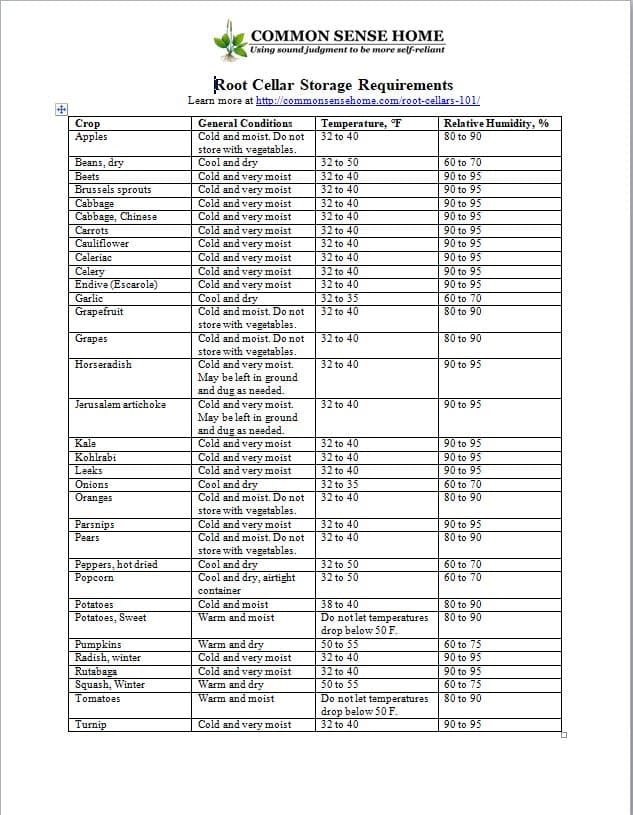
Fruit and Vegetable Storage Chart

The chart below gives preferred temperature and moisture ranges for root cellar storage of a variety of fruits and vegetables. Adapted from the University of Missouri Extension Office. 

root cellar storage chart

Root Cellar Location – In the Basement or Buried Outside?

By default, the word “cellar” means “underground”. A big part of why root cellars work as well as they do is that the earth remains at a relatively constant (cool) temperature. This temperature will vary, depending on your location. Closer to the equator, and it may be cooler than air temp, but still isn’t likely to act well as a root cellar. At the opposite extreme, you have arctic permafrost, which the native folks use to store whole animals.

Retrofitting a Root Cellar in an Existing Home

The easiest option for building a root cellar is to section off a part of the basement (or maybe even the whole basement, if you live in an old farmhouse) for produce storage. Old dirt floor basements without heat are great for maintaining proper temperature and humidity levels.

Select an area with an existing window if possible, and use the window for ventilation. Fill the window with exterior grade plywood, and cut the necessary vent holes through the plywood. (The plywood also helps block light.)

North facing corners work well, because you can leave the two exterior walls uninsulated, and only insulate the interior walls. A north facing wall won’t gain heat from the sun. Use materials that tolerate moisture exposure.

Your basement root cellar should have no standard heating or cooling. Take note of ductwork or piping that runs through the ceiling above your root cellar (if any), and make sure vents or hot water pipes are well insulated so they don’t bleed heat into your root cellar.

For additional food storage space, build shelving on the outside of your basement root cellar for canned goods or other items.

During a SHTF situation, pain could become an annoyance for some, but unbearable for others.
If doctors are scarce and medicine becomes even scarcer, this one little weed, found all over North America and similar to morphine, could be a saving grace.

Adding a Root Cellar in a New Home

Many new homes have small concrete exterior porch. Typically this area has 4ft footings and is filled under the porch with dirt. You need to put a foundation wall under it anyway, so why not put this area to good use?

To turn this under porch area into a root cellar, have the builder put in full footings, an insulated exterior grade access door from the basement and two 4 inch vent holes. Add concrete slab on top as normal. This area could also be a wine cellar or safe room.

Our under porch root cellar measures about 6’x8′, which provides plenty of room for our stash of root veggies, plus gives a nice sized porch above. Locating the root cellar outside the footprint of the home allows the root cellar to maintain cooler temperatures more easily than a cellar located within the house.

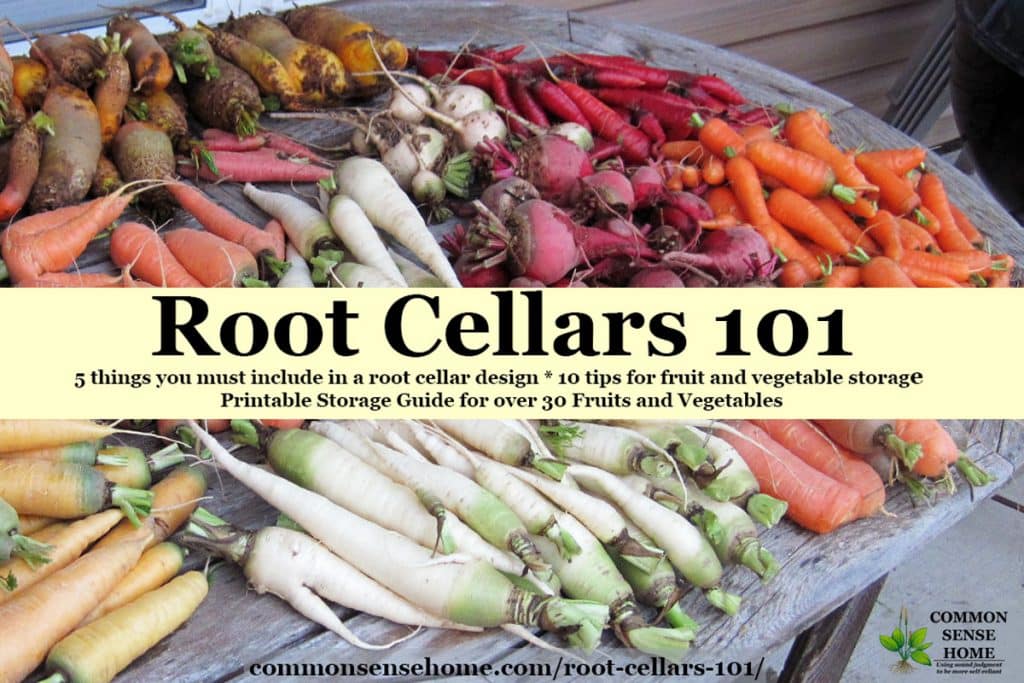
"root cellars 101" test over table piled carrots and beets

Building a Root Cellar Outside the Home

For an exterior root cellar, similar rules apply – have good ventilation, keep it earth sheltered and dark. A north facing door is preferred, to avoid sun beating in and heating your cellar up. Aim for at least one to two feet of soil covering the root cellar, and make sure you choose a premade option (some people have used new septic tanks) or materials that are rot resistant and can stand the weight of wet soil.

Traditional Root Cellar

This is what most of us think of when we hear the phrase “root cellar”. There are insulated doors that lead down into the earth. It’s dug down or into the side of a hill. Walls are concrete, cinder block, or more creative materials like old tires. You need to make sure the roof and walls are well supported to avoid collapse. Engage an engineer to help ensure safety.

Earth Berm Root Cellar

Above ground root cellars are usually partly sunken with earth mounded on 3 sides and the door avoiding the direct sun. See the  Above Ground Root Cellars post for more information.

For a great resource on building a homestead root cellar, check out the book below by my friend, Teri, of Homestead Honey.

Barrel in the ground A (approximately Zones 6-9)

The size and depth depends on the zone you live in. A simple bucket, with holes drilled in the bottom and top, buried level with the soil with a bale of hay as an insulating cover will work into zone 7 and possibly into zone 6 depending on cover and conditions. The colder and hotter zones require the bucket or barrel to be deeper, and more insulation on the top to avoid the freezing surface temps.

Barrel in the ground B (approximately Zones 3-6)

Buy one large heavy duty garbage can, and a smaller garbage can that fits inside the larger one (with an inch or two gap). Both the larger garbage can and the smaller one need holes in the bottom. The inside one needs a cover with vents / screen. Cover exterior holes with screens to keep rodents out. It also needs significant insulation above it.

Prepare a hole that is deeper than the large garbage can, with rocks and gravel in the bottom to create a simple French drain. If water drains well, you will need a small amount of rocks and gravel. If soil doesn’t drain well, you need to go deeper and wider so your underground storage barrel doesn’t turn into a water hole. Another trick is to dig a very deep, large hole next to the garbage can hole and fill that hole with rocks. The deeper hole acts as a drain for your shallower garbage can root cellar.

Once you have the large garbage can in the ground and secure, lower the smaller one into the larger barrel. Store food in the small barrel. When you need access, grab from the top or pull out the smaller barrel. This makes it easier to reach food the bottom. There are many variations on this. Search “garbage can root cellar” for examples.

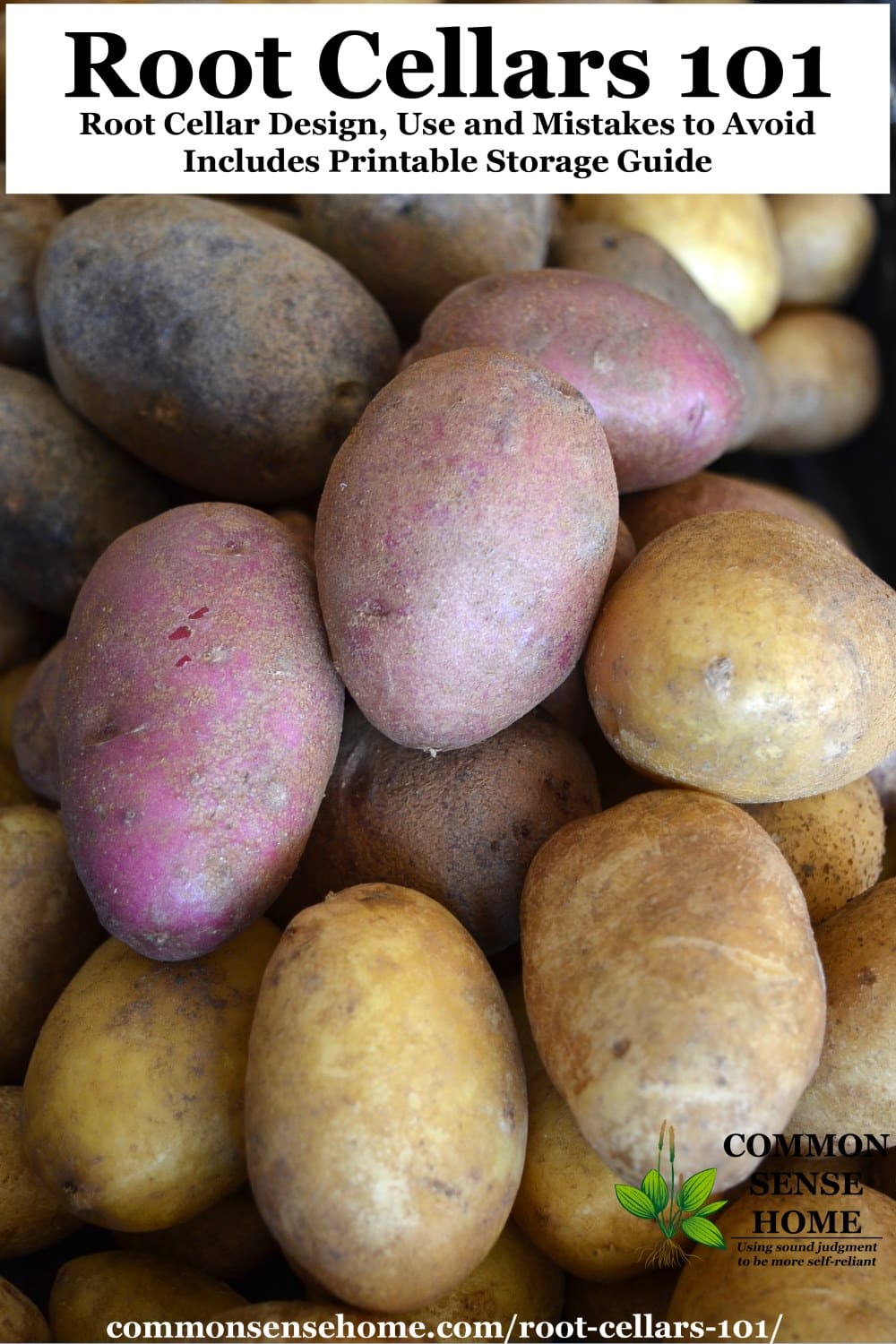
stored potatoes

Root Cellar Ventilation

Improper ventilation is one of most common mistakes that people make when designing/installing a root cellar. They build their underground food storage airtight to keep things nice and cold, and everything spoils. Why? Because some foods give off ethylene gas, which speeds ripening (and rotting). A root cellar that is too airtight may also build up excess humidity, leading to mold and mildew.

How should you ventilate your root cellar? Use two vents, about 3-4 inches in diameter. Place the vents so that one is near the top of the root cellar to exhaust stale air and ethylene gas. The other vent should be run down to near the floor, to drop in fresh air. 4 inch vents should be adequate for to up to around an 8’x10’ room. If your cellar is larger than this, consider additional ventilation. Make sure to put screen on the outside to keep mice and other small animals out!

Ethylene Gas

As fruits such as apples and pears ripen, they give off ethylene gas, which decreases the storage life of some produce. Ethylene gas can cause sprouting, decay, mold, yellowing, shrinking, toughness, softness, bitterness and other damage.

To combat spoilage from ethylene gas, segregate fruits and veggies that produce excess ethylene gas from those that are easily damaged from ethylene gas. (This is a good idea for your refrigerator produce bins, too.)

Fruits and Vegetables that may create excess ethylene gas include:

Apples, apricots, avocados, ripening bananas, blueberries, cantaloupe, citrus fruit (not grapefruit), cranberries, figs, guavas, grapes, green onions, honeydew, ripe kiwi fruit, mangoes, melons, mushrooms, nectarines, okra, papayas, passion fruit, peaches, pears, peppers, persimmons, pineapple, plantains, plums, prunes, quinces, tomatoes and watermelon.

Fruits and vegetables that may be damaged by excess ethylene gas include:

Asparagus, broccoli, Brussels sprouts, cabbage, carrots, cauliflower, chard, cucumbers, cut flowers, eggplant, endive, escarole, florist greens, green beans, kale, kiwi fruit, leafy greens, lettuce, parsley, peas, peppers, potatoes, potted plants, romaine lettuce spinach, squash, sweet potatoes, watercress and yams.

Root Cellar Lighting

Light exposure is the enemy of food storage. Every time I see people lining up their canning jars or spices on open shelves, I cringe. It looks beautiful, but light bleaches out the color and the nutrient value of foods.

In the root cellar, light exposure may lead to sprouting and green potatoes. If you’re venting through a window, cover the rest of the window. If you have a light in your root cellar so you can see your food storage better, don’t leave the light on when you’re not using it. A hunk of burlap drawn over bins of potatoes or fruit will allow ventilation while still blocking the light. A single incandescent light (switched on exterior) should provide adequate lighting (unless your room is really huge) and, if for some reason your storage gets too cold, you can always use it to introduce a little heat.

Solar energy is a renewable source of energy with has many benefits.

The best thing is that you’ll save money on you electric bill.

To build your own solar panel almost for free, you’ll need to watch this video

Root Cellar Humidity – Keep Things Moist But Not Wet

Checking the fruit and vegetable storage chart, you’ll see that most store best with fairly high humidity. If you have a dirt or gravel floor in your root cellar, you’re in luck, because the natural ground moisture will help keep your produce damp.

Produce will give off some moisture on its own, but if you note that your produce is shriveling, your root cellar is probably too dry. Take a tip from the grocery stores, and try a little misting action with a spray bottle. Avoid getting any area too wet, as that can lead to standing water and potential mold growth. Some people leave trays of water in the root cellar to increase humidity. Be careful with this option, as it can also result in bacteria or mold growth.

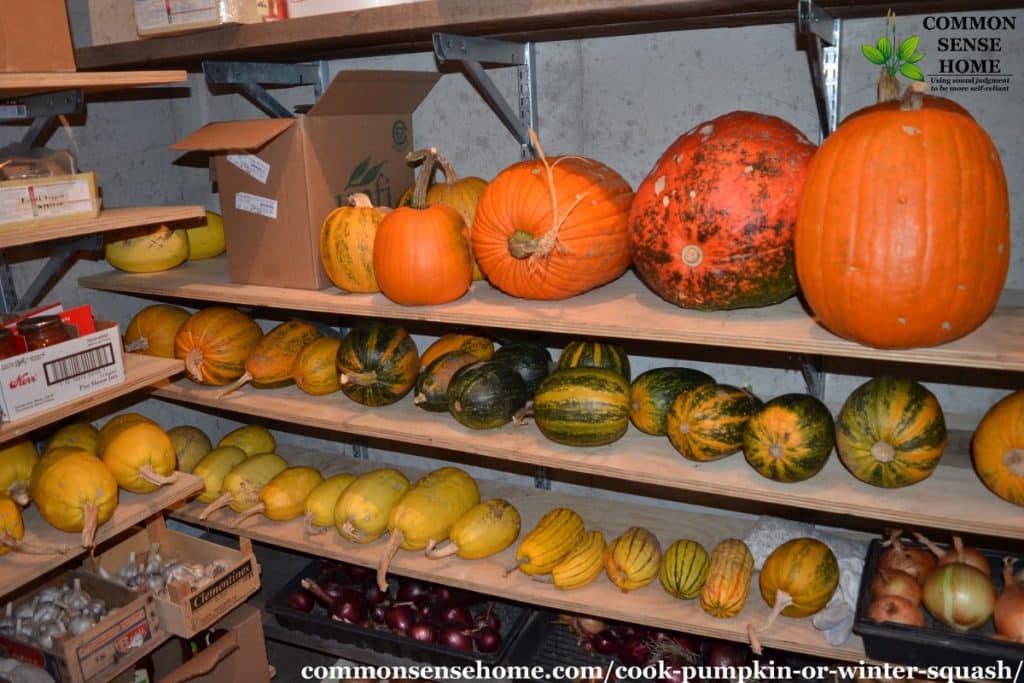
pumpkins and squash

Root Cellar Shelving

Shelving should allow airflow and add storage. Keep a gap between the shelving or storage bins and wall to encourage air flow. Remember to check the chart and keep produce that likes cooler temps lower and food that like warmer temps higher.

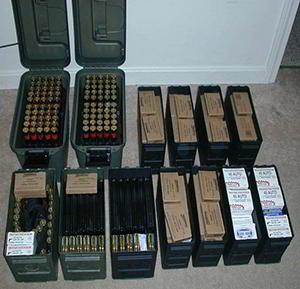
How And Where To Store Ammo- Like Food, And Water, Ammunition Should be Something That Is Prepared For Beforehand

If and when the SHTF you won’t have time to buy ammunition. In 2012 in the face of pending gun control ammunition dried up for over a year. Imagine if there was a real long term survival situation? Even if it was a gradual shift into a bad situation the ammunition supply would be one of the first things to go. Factor in that no one would be producing ammunition anytime soon and ammunition would be gone, completely and totally.

Like food, and water, ammunition should be something that is prepared for beforehand. People should store and purchase ammunition in advance just in case of a bad situation. Purchasing ammunition is easy, storing it for long term might be a little more difficult. So how, and where do you store your bulk ammunition?

Where To Store

This is the million dollar question. Where do we store ammunition for it to be both secure, and safe? A lot of this will have to do with the amount of ammunition you plan to store, but in general there is a simple set of guidelines you can follow.

1.Safety

First and foremost safety is always a priority. Regardless of where you decide to store your ammunition it needs to be in a safe location. For some this means out of the reach of children. Ammunition is certainly a choking hazard, and its flammable, and of course toxic in many cases. So young kids and ammo never mix.

There is also some minor concerns if you have a dog that likes to chew. If you expect to use plastic containers or cardboard be aware that if your pup is a chewer he may enjoy the wrong snack.

In general ammunition should be stored away from from anywhere that has an open flame, but that is just common sense.

2.Security

Ammunition is a great investment, it rarely loses value, and when ammo crisis hit hit they hit hard and fast. Ammo prices skyrocket, and in a seriously SHTF situation ammo will be more valuable than gold. Security is key to protecting your preparations. Security in ammo goes a few different ways.

First and foremost I suggest keeping a combat load ready in magazines at all times. This is just in case things happen faster than you can predict. A combat load is at least 6 magazines for a rifle and 3 magazines for a handgun. These should be locked away in a safe preferably. This ammunition should also be cycled out and shot at the first sign of deterioration.

When storing ammunition it may get to the point where you have too much to effectively hide in one location. So do not be afraid to store ammunition in multiple locations. I also recommend keeping it under lock and key if possible.

What to Watch when Buying Ammo For Long Term Storage

First and foremost when buying ammo to store long term be prepared to replace the box it comes in. Cardboard boxes suck at keeping moisture out so they should not be the primary storage option.

ammo-storage-containers

Loose ammo is also a no go. Unless you are planning to store it primarily short term I suggest finding an alternative. The reason being is that you never know how long that ammo has been loose and rattling around it may not be reliable, or may have already be exposed to moisture.

Some ammunition comes pre packaged in waterproof, moisture proof containers. Ammunition coming out of Russia and the Eastern Bloc in general is often stored in metal tin canisters that are completely moisture resistant as long as they are sealed. Same goes for ammunition in NATO battle packages. A common theme among ammunition made for the military is often made waterproof.

Humidity

Humidity is a killer of ammunition. It can rust the case, deteriorate the primer, and ruin the powder. Preventing humidity is the most important step in preserving ammo for the long term. While the tactic of hiding ammunition in multiple locations is a good one, it is usually best to find the room with the lowest possible humidity and store your ammo there, you can focus on hiding after the ball drops.

Monitoring humidity isn’t too difficult. You can purchase test strips for about a buck apiece to give you an idea of the humidity in the area you store your ammunition. I would advise putting them in your actual ammo boxes. You can find these commonly in stores that sell wooden instruments.

If humidity is a problem, consider a room sized dehumidifier. This can solve quite a few problems if you live in a humid environment, and hey, it is good for the air in your house.

Proper Containers

ammo-cont

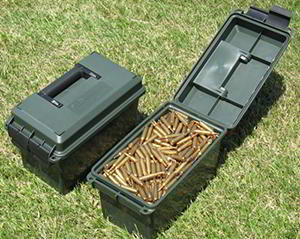
Proper containers are a must have for storing ammunition. The box ammunition comes in is rarely suitable for long term storage. Proper containers include waterproof, sealed ammo boxes. Military surplus cans are an excellent start. In my time in the Marine Corps I saw those basic ammo cans sit through torrential downpours for weeks at a time and never spring a leak. They can’t be submersed but they can resist moisture at almost any other level. Alternatively, plastic ammo cans with rubber seals are also excellent to store ammunition, and incredibly cheap. Lastly there is always tupperware, it’s waterproof and works wonderfully.

Invest in Silica

Silica gel packs are these tiny little packets that absorb moisture and prevent it from gathering in your ammo can. These packets are quite affordable, easy to find, and work wonders. If you’ve ever bought a new pair of shoes they’ve probably had these packets in them. Silica is a desiccant, that means it absorbs water.

Long Term

Long term ammo storage isn’t difficult. All it takes is an ounce of preparation to prevent a pound of pain. Being prepared is critical to survival and success, but sometimes looking after your preps is just as important as prepping. Long term ammunition storage is one of those preparations for your preparations.

The First 15 Foods You Should Stockpile For Disaster

A good stockpile of food will go a long way toward helping you survive the aftermath of any disaster or life crisis, especially when grocery stores are emptied.

In fact, I’d go so far as to say that there are people who are not preppers who nevertheless instinctively know to stockpile food. This really isn’t surprising when you consider that through most of mankind’s history, stockpiling food was essential to survival — specifically surviving the winter months. During those months, wildlife is bedded down trying to stay warm and plants are dormant. If one didn’t have a good stockpile of food, their chances of survival were pretty darn slim.

During a SHTF situation, pain could become an annoyance for some, but unbearable for others.
If doctors are scarce and medicine becomes even scarcer, this one little weed, found all over North America and similar to morphine, could be a saving grace.

But knowing to stockpile food and knowing what to stockpile are two different things. The vast majority of what the average American family eats is unsuitable for stockpiling, because it falls into one of three categories:

  • Junk food – Lots of carbs, lots of sugar, lots of salt and lots of chemicals, but not much nutrition.
  • Fresh food – Foods that won’t keep without refrigeration.
  • Frozen food – It will begin to spoil within two days of losing electrical power.

So we need to come up with other foods — foods that will give us a lot of nutrition and also have the ability to be stored for a prolonged period of time. Here are what we consider the 15 most important ones:

1. Beans – This is one of the more common survival foods. Not only are beans plentiful and cheap, but they provide a lot of protein — something that’s hard to find without meat.

2. White rice – The perfect companion to beans. An excellent source of carbohydrates, and it stores well. [Note: Don’t store brown rice, which contains oils and will spoil.]

3. Canned vegetables – A good way of adding micro-nutrients to your survival diet. Canned goods keep well, long past the expiration date on the label.

4. Canned fruit – For something sweet, adding canned fruit allows you a nice change of diet. Being canned, they keep as well as the vegetables do.

5. Canned meats – Of all the ways of preserving meat, canning is the most secure in protecting the meat from decomposition. While it doesn’t typically have as good a flavor as fresh meat, it still provides animal protein at the most reasonable price you’ll find.

6. Honey – As long as you can keep the ants out of it, honey keeps forever. Plus, it is beneficial during cold season.

7. Salt – Nature’s preservative. Most means of preserving foods require the use of salt. In addition, our bodies need to consume salt for survival.

8. Pasta products – Pasta is a great source of carbohydrates, allowing you a lot of variety in your cooing. Besides that, it’s a great comfort food for kids. Who doesn’t like spaghetti?

9. Spaghetti sauce – Obviously, you need this to go with the pasta. But it is also great for hiding the flavor of things your family doesn’t like to eat. Pretty much anything, with spaghetti sauce on it, tastes like Italian food — whether you’re talking about some sort of unusual vegetable or a raccoon that you caught pilfering from your garden.

10. Jerky – While expensive to buy, jerky is pure meat, with only the addition of spices. Its high salt content allows it to store well, making it a great survival food. It can be reconstituted by adding it to soups and allowing it to cook.

(21 wild edibles you can find in urban areas)

11. Peanut butter – Another great source of protein and another great comfort food, especially for the kiddies. It might be a good idea to stockpile some jelly to go with it.

12. Wheat flour – For baking, especially baking bread. Bread is an important source of carbohydrates for most Americans. Flour also allows you to shake up the diet with the occasional batch of cookies or a cake.

13. Baking powder & baking soda – Also for making the bread, cookies or cakes.

14. Bouillon – Otherwise known as “soup starter,” this allows you to make the broth without having to boil bones on the stove for hours. Soups will probably be an important part of anyone’s diet in a survival situation, as they allow you to eat almost anything. Just throw it together in a pot and you’ve got soup.

(Here are 23 survival uses for honey that you didn’t know about.)

15. Water – We don’t want to forget to stockpile a good supply of water. You’ll go through much more than you expect. Experts recommend a minimum of one gallon per person per day, but remember: That’s just for drinking.

While this doesn’t constitute a complete list of every type of food that you should stockpile, it’s a good starting point. You’ll want more variety than this, but in reality, your family can survive for quite a while with just the 15 things on this list.

As your stockpile grows, add variety to it. One way of doing that is to create a three-week menu, with the idea of repeating that menu over and over. If you have everything you need to cook everything on that menu, you’ll have a fair assortment of food, and enough so that your family shouldn’t grow tired of it.

Preparedness Hacks: Once a nuke is heading your way, you might think that there isn’t much left to do, but you would be wrong!

Because we will show you America’s natural nuclear bunkers that are also EMP proof. When the sirens start wailing, all you need to do is pick the closest one to your home, where you can take cover before it hits.

Do You Know These 25 Native American Survival Skills?

Native American survival skills included crafting their own survival tools and building their own shelters. They foraged for their food and hunted their prey, all by hand. It is astounding to think how well they survived and thrived based on necessity alone. Would someone like you or me be able to do the same if we were put into such a hostile environment? Probably not, and that it is why it is good to be aware of old-school Native American survival techniques. How did the Native Americans survive? How were they so deftly able to sustain themselves in the unforgiving North American wilderness?

It is very easy to forget, in our modern times of the Internet and instant heat, cooling, food, and shelter, that people use to live a much simpler and much harder life before the advents of these modern comforts. The Native Americans are the prime example of how people use to live off the land and survived the threats of nature with basic and cultivated survival tactics.

During a SHTF situation, pain could become an annoyance for some, but unbearable for others.
If doctors are scarce and medicine becomes even scarcer, this one little weed, found all over North America and similar to morphine, could be a saving grace.

Native American Survival Skills We Can All Learn From

This list will highlight 25 of some of the more interesting Native American survival skills commonly used by the tribes of North America. Let this list be an insight into the lives of these fascinating people, an educational tool for our modern culture, a means of appreciating a society that is so rare and thin today and a reminder that the human spirit and will are much stronger than what we give them credit for.

25. Community

The tribal mindset and lifestyle of the Native Americans of yesteryear play a huge role in their survival tactics. As you probably are already aware, Native Americans distinguished themselves by tribes. You have probably already heard of the more common and prominent tribes like the Apache, Navajo, and Mohican. The sense of community, sharing of resources and wisdom and collective protection between tribesmen cannot be understated when considering how Native Americans were able to survive.

24. Footwear

If you have ever worked a day in your life wearing the improper pair of shoes then you know how important footwear is to comfort and bodily health. Footwear was integral to Native American survival and moccasins made of tanned leather and sewn together were common in North American tribes. Although designs and cuts differed from tribe to tribe, features like rabbit pelt for added warmth and hardened rawhide for increased durability were common attributes of moccasins.(21 wild edibles you can find in urban areas)

23. The Fox Walk

The fox walk was a method of tracking, traversing and hunting stealthily for Native Americans. This specific style consisting of wearing thin moccasins to feel the ground better, landing on the heel first and rolling your foot down, and traveling in lines to conceal your numbers was used in battle and in hunting.

22. Preserving Meat

Meat got many Native American tribes through harsh winters, but there were no chemical preservatives or refrigerators back then. Instead, Native Americans would preserve meat by cutting it into lean strips, eliminating fat, and drying it in the sun. This is essentially what we know today as beef jerky. This thin, dried meat can keep for a very long time and was an essential food supply for Native Americans. We put together a guide to preserving meat in the wilderness.

21. Animal Hides

Animal hides were essential to Native American life and key to their survival. By honing a process of tanning and smoking, Native Americans were able to turn raw animal hides into moccasins, clothing, and even shelter.

20. Natural Observation

Being able to tell what kind of weather was on the horizon was a huge asset for Native Americans. They used the natural signs of the environment to predict weather and to prepare accordingly. They would study the behaviors of animals who have much keener senses for weather than we do and read the clouds. Here are 23 survival uses for honey that you didn’t know about.

19. Using Plants

How Native Americans were able to discern the healing powers of certain plants is an unknown but we do know that these practices were handed down from generation to generation so it was probably a case of trial and error. They would use plants, herbs, and other life found in nature to heal wounds and treat illnesses.

18. Artful Crafting

Native American skills and crafts work with materials from their environment. By turning the crafting of basic survival tools and shelters into works of art, Native Americans were able to make the essentials of life that would stand up to the rigors of their environment. Native Americans took their time to craft tools and shelters thus ensuring their durability and overall quality and helping them survive in harsh conditions.

17. Body Paint

Before hunts, Native American tribes would paint their bodies so that they could blend into the natural scenery, as stealth was a very important aspect of survival in those times.

16. Clothing

Proper clothing is essential for anyone to survive in any situation, and the Native Americans had their clothing crafting skills down to a science. They used animal hides and smoked leather to create warm clothing for the cold winters. They also used certain colored clothing for stealth when hunting prey.

15. Camps

The Native Americans often built temporary camps for hunting excursions but they still needed to maintain a certain level of stealth. They would build these camps with earth-toned materials and animal skins and tuck them into the base of foothills or other strategic natural sites so that they would be hard to spot from a distance.

Preparedness Hacks: Once a nuke is heading your way, you might think that there isn’t much left to do, but you would be wrong!

Because we will show you America’s natural nuclear bunkers that are also EMP proof. When the sirens start wailing, all you need to do is pick the closest one to your home, where you can take cover before it hits.

14. Blow Guns

These have become something of a novelty in today’s day and age but blow guns were actually used for hunting and in warfare by Native American tribes such as the Cherokee. They would fashion these weapons out of cane or reed. The reed would be hollowed out to a tube wherein a dart would be inserted and propelled by a strong breath towards a target. Blowguns were used primarily to kill small game like birds, rabbits, and squirrels and were sometimes tipped with poison extracted from venomous snakes and even Gila Monsters.

13. Deadfalls

Deadfalls are a kind of trap that was used by Native Americans to kill their prey. A heavy rock or log would be elevated by rope or a lever made of wood over a piece of meat or food to entice an animal. The deadfalls usually had a trigger that when the animal touched it, would activate the primitive trap and send the heavy object crashing down on them.

12. Snares

Trapping was one of the main ways that Native Americans caught their food and snares were among the most common types of traps utilized. A snare uses a vine that is tied in a loop and attached to a young sapling that is bent over and is fastened by tying it to a stick driven into the ground. The loop goes around a piece of meat to entice an animal and when the animal puts its head through the loop and tries to make off with the bait, the stick is dislodges and the loop turns into a noose around the prey’s neck and is suspended in the air as the sapling, free of its fastener, springs back into an upright position.

11. Trapping Pits

This is one of the more straightforward survival tactics utilized by the Native Americans. As the name suggests, this trap is simply a dug pit sometimes fitted with spikes at the bottom to kill or bleed the trapped animal. The dug pit would be covered up by branches and earth so that unsuspecting animals would walk over it and fall in.

10. Fishing Weirs

Fish is an indispensable food for Native Americans and among the ways that they would catch fish were fishing weirs. Fishing weirs are essential traps built by rock or wood that would lead fish migrating up or downstream to a corridor built to be narrow, ultimately trapping the fish.

9. Spearfishing

Another way the Native Americans caught fish was by spearfishing. There were different methods of spearfishing employed depending on the time of year. In the winter when the lakes would freeze over, a hole was cut into the ice and a lure made of bone was used to entice the fish toward the hole. Then, a spear made of wood for the shaft and copper or bone for the tip punctured the fish.

8. Hunting Tactics

It may seem simple now that we look back but many hunting tactics devised by Native Americans were learned over the generations and used to help them survive. Simple tactics like reading the wind and standing downwind from a target increased the chances for success of a hunt dramatically.

7. Nomadic Practices

Not all Native American tribes stayed in one place. After the Spanish visitors brought horses to the great plains, many tribes such as the Blackfeet, Crow, and Comanche adopted a nomadic lifestyle in order to hunt buffalo across the plains all year round. This supplied for them a stable food source and ensured, to a certain degree, survival.

6. Teepees

Of course, there can be no survival without some form of shelter. The Great Plains Native Americans knew this very well and built teepees which are essentially tents. They were commonly made from buffalo hides and long wooden poles.

5. Dedicated Tribe Roles

A lost every aspect of Native American life was spurred by survival. This is even true of the gender roles of the Native Americans. The men were the hunters and to prevent any waste which could mean the difference between life and death in the North American frontier, the women were the cooks. They would prepare the meat that the men brought back immediately so as not to waste a single morsel and ensure that they had plenty of food.

4. Bows

An indelible image that most people have of Native Americans is the bow and arrow which was vital for the survival of all tribes in North and South America. Most bows were fashioned out of wood and strengthened with animal tendons. Bowstrings were made from animal tendon or yucca and similar natural fibers.

3. Axes

There are certain tools that are as essential now as they were in the days of the Native Americans for survival. Among them is an ax. While Native Americans used axes for warfare, they were also used to chop wood that would be used for many different causes and to hunt prey.

2. Water

This may seem a simple and almost thoughtless aspect of survival but the fact of the matter is that if the Native Americans did not have sources of fresh water to draw from, they would have never survived. The plentiful rivers and lakes of the Americas helped sustain the Natives and they regarded water sources with great reverence.

1. Fire

There is no life without food and warmth and fire is number one on the list of 25 essential survival skills that kept Native Americans alive because it provided both. There were many methods of building fires among Native Americans but among the most common were striking stones like pyrites together to create a spark that would be caught be a pile of tinder. The friction caused by rubbing two sticks together also generated enough heat to combust tinder. Bow drills and fire pump drills were also common methods of starting fires. These contraptions used string wrapped around a stick and controlled by a bow to generate the heat needed to start a flame.

Check out this cool video from Tim Jones for some Native American fish trap idea:

Though the methods and practices of Native Americans varied from tribe to tribe, the innovation for the sake of survival was universal. They borrowed methods from each other and created ones unique to their tribe. They even borrowed from foreign settlers and visitors. The Native Americans were a group of humans that had to learn how to adapt and we are all the richer and wiser for their survival efforts. It is hard to separate the survival tactics we employ today from those introduced to us by the Native Americans. Thus, we owe a debt of gratitude to these people who learned how to tame the wild Americas and make them a place hospitable for human life.

Solar energy is a renewable source of energy with has many benefits.

The best thing is that you’ll save money on you electric bill.

To build your own solar panel almost for free, you’ll need to watch this video

Have you tried any of these Native Americal survival skills in real life? Share your thoughts about them with us in the comments section below!

Pioneer Foods We’ll Be Eating A Lot After SHTF

Once upon a time, heading on down to the grocery store to fill the pantry whenever you needed to was not an option. Pioneers who traveled west in pursuit of religious freedom and a better life in the early days of U.S. settlement aimed to settle in areas where chances to buy supplies were few and far between.

This meant that they had to be self-sufficient, which required bringing along and preparing food that would last a long time, tending animals and hunting as needed, and eating what the land provided them.

While this self-imposed self-sufficiency is truly a measure of how passionate and hardworking the pioneers were, it’s also a glimpse into a future without the modern-day amenities we all enjoy in 21st-century America. If ever a situation arises that leads to the collapse of society as we know it, those pioneer foods may be more like our bread and butter (pun totally intended). Here are some foods that we’ll all have to become familiar with if doomsday happens.

Preparedness Hacks: Once a nuke is heading your way, you might think that there isn’t much left to do, but you would be wrong!

Because we will show you America’s natural nuclear bunkers that are also EMP proof. When the sirens start wailing, all you need to do is pick the closest one to your home, where you can take cover before it hits.

Cornmeal

A favorite of Native Americans, cornmeal was often used in place of today’s more traditional wheat flour because it could be easily ground from whole corn while on the move. Bread, cakes, and pancake-like products were often made from cornmeal. It’s got the added bonus of a little sweetness that could be hard to come by in a SHTF situation. If you’d like to see how to make Corn Pones just like the Native Americans, follow this link: https://www.facebook.com/askaprepper/videos/2068662080037588/.

Dried or Cured Meats

Without refrigeration, meat from large animals like cattle, pigs, deer, and so on will have to be handled differently than it is today. Smoking, salting, and drying were all techniques employed in the pioneer days to keep meat from spoiling, and they’d be a handy way to keep our families fed for the long haul if we lose access to refrigeration. While cured and dried meats are more a novelty today, you can bet they’d quickly become a staple in more trying times. Here’s a long-forgotten recipe on how to make delicious lard with 2 years shelf-life (+ 5 tasty recipes)

Wild Game, Especially Small Game

You don’t find a lot of people eating squirrel and wild rabbit these days. However, a squirrel or rabbit that was happened upon and harvested in pioneer times surely wouldn’t go to waste. Fresh meat was few and far between, with the bulk of protein coming from dried or cured meats, and taking large game wasn’t very practical if you were on the move as you’d likely wind up wasting much of the meat. Small game was perfect for feeding you for a day, though. That’ll be very important, especially as people are likely to take on more nomadic lifestyles post-doomsday.

This also includes fish and native shellfish. In many places, fish may be even easier to get your hands than rabbits and squirrels. Learning about the local varieties could make it much easier to add some protein to your dinner. And here’s how to make delicious Biltong with 1 year-shelf life.

Animal Fats

Lard and other fats rendered from animals are definitely not the go-to these days, but they were far more readily available in pioneer society – and they were also a lot easier to process than the vegetable-based oils you’ll find in the average cabinet today. Because fat is a crucial part of our diets, animal fats are likely to make a comeback after doomsday.

Dried Fruits and Veggies

We know that drying produce is a great way to preserve it. People enjoy dried fruits and veggies even in modern times. However, if our society breaks down and leaves us with zero access to out-of-season produce and more modern preservation methods like canning and freezing, dehydrating fruits and veggies is likely to become common practice. You can even preserve produce this way using only the power of the sun.

Dried Beans

Beans tend to be fairly easy to grow, and dried beans can last a very long time. Pioneers packed dried beans to provide protein and fiber along the trail, and they’ll likely be popular for their high protein count and filling nature if ever the SHTF. You also don’t need much to prepare dried beans; a pan, water, heat, and a little patience is all it takes. Bonus: When you settle in somewhere, you can plant those babies and get a whole new crop ready for the next year.

Squash, Tubers, Onions, Garlic, and Apples

What do all of the above have in common? Aside from being fairly commonplace now, all of these produce items can be stored for fairly long periods in cool, dark places. As long as a little care is taken in storage, these will last through most of a winter. You commonly see references to these items in all sorts of literature written in earlier days, and root cellars were commonplace up until a few decades ago. If fresh produce was out of the question, wouldn’t some delicious fried squash or potatoes be an absolute treat?

Maple Syrup and Honey

While we as a society are pretty dependent on modern sugar, it was much harder to find in the days of the pioneers. In fact processed sugar was an expensive luxury for most people. Instead, they used other sweeteners like honey and maple syrup to help sweeten their dishes. Those items will likely become much more common in a SHTF situation because they’re easier to process than white sugar. With a little knowledge, and very minimal equipment that could be improvised easily, the common man can get syrup from tapping trees. A little bravery would certainly be necessary to collect honey, but it’s not impossible. Here are 23 survival uses for honey that you didn’t know about.

Foraged Foods

Obviously the foods you’d be able to forage vary from region to region, and the same was true for the pioneers, too. They’d forage local berries, greenery, wild fruits, mushrooms, and herbs to supplement their diets and add variety. If the SHTF it’ll pay dividends to be aware of the edible plants found in your region and have an idea of where to find them. These wild foods may also be propagated for home gardens if seeds and plants are unavailable for planting the more common gardens we see today. Here are 21 wild edibles you can find in urban areas.

If society collapses, you can bet that the foods the pioneers ate will become dietary staples. Those foods were wholesome, nutritious and, most importantly, available. Do yourself a favor and learn a little about how to find, prepare, and store these foods now, so that you’ll be prepared to feed yourself and your family in a SHTF situation

During a SHTF situation, pain could become an annoyance for some, but unbearable for others.
If doctors are scarce and medicine becomes even scarcer, this one little weed, found all over North America and similar to morphine, could be a saving grace.

10 Simple Survival Shelters That Will Conquer The Elements

The Ultimate Guide To Building, Finding, and Deploying Survival Shelters

There’s more than one way to skin a cat.

And there even more ways to find, build and deploy survival shelters.

But only if you know what you’re doing.

In this guide, we show you our 10 favorite simple-to-build survival shelters.

And we don’t just show you, we teach you with how-to videos.

So in this article, we’ll cover the following survival shelter topics:

  • Why Learn How To Build A Survival Shelter
  • 3 LifeSaving Shelter Tools
  • 10 Best Survival Shelters
    • Simple Tarp Shelter
    • Variations Of The Tarp Shelter
    • Debris Shelter
    • Spider Shelter
    • Ultimate Wickiup
    • Survival Hut
    • Snow Cave
    • Igloo
    • Juniper Tree Shelter
    • Dug Out Shelter
  • Survival Shelter Action Plan

Why Learn How To Build A Survival Shelter


I love the great outdoors but I hate feeling exposed.

Wait, don’t those two statements contradict each other?

Yes, they do if you don’t know how to build a survival shelter.

But if you can build one…then the answer is: No.

Let me explain.

Riding out Mother Nature’s worst without shelter is not only a crappy time; it’s also deadly.

When unprepared humans go up against extreme weather, weather wins. You lose.

And even if the weather decides to “play nice,” it’s comforting to know how to build a safety barrier between you and the rest of the world.

Cold, wet, heat and dangerous animals all reduce your chances of survival.

And at the extremes (blizzards, torrential downpours, heat waves, and attacks), you’re survival window slams shut.

So if you can’t build, find or deploy a survival shelter fast in the harshest conditions, you’re done for in mere minutes.

That’s why sheltering is essential to your survival.

Whether you’re planning a wilderness bug out or just want to be ready for an unexpectant emergency.

Everyone should learn the skill of building, finding and deploying survival shelters.

Now before we continue:

Not all survival shelter designs work in all environments.

For example:

A good forest survival shelter will not work in deep snow or the hot desert.

So I’ll also break this article into the following categories as well:

  • Forest Survival Shelters
  • Snow Survival Shelters
  • Jungle Survival Shelters
  • Desert Survival Shelters

So let’s start things off with the simple lifesaving emergency shelter tools.

Because you should never make survival harder than it needs to be.

3 Lifesaving Shelter Tools


Emergencies are, by definition, unplanned events:

“A serious situation or occurrence that happens unexpectedly and demands immediate action.”

The most important word here is UNEXPECTEDLY.

You were caught off guard. You didn’t expect the event but never-the-less; stuff happens.

We cannot prevent all emergencies situations from our lives, however, we can prepare for the unexpected.

Or as they say “expect the unexpected.”

So how do you do this in regards to survival shelters?

1 – A Quality Survival Tarp

By purchasing several good survival tarps and stashing them in your vehicle, your bug out bag, your day pack, etc.

I’m often asked which survival tarp I consider the best.

Aqua Quest Defender Tarp

It’s 100% waterproof, extremely durable, lightweight, compact, and includes over 20 reinforced loops for versatile setup in any situation.

Remember, when it comes to survival tarps, you get what you pay for.

2 – Paracord

And as we’ll cover in more detail shortly, you’ll also benefit from having a bit of paracord with you at all times.

TITAN WarriorCord

Paracord has many survival uses, but with shelter building, it’s essential for securing tarps and lashing wood together.

And while some paracord is better than others, most will work for building survival shelters.

I recommend getting some Titan Warrior Cord. It’s proven, tough and is ideal for survival.

3 – Tact Bivvy

The third item I recommend you invest in for survival is the Tact Bivvy

Tact Bivvy Survival Sack

It’s the ultimate solution to keeping you warm under your survival tarp.

Sleeping bags are too bulky to stash in small spaces and take with you for random emergencies.

However, the Tact Bivvy fits in your hand and is designed with NASA Mylar heat reflective technology.

It’s worth investing in one for each of your vehicles.

So with just these three simple items (a survival tarp, some quality paracord, and a Tact Bivvy), and a bit of shelter knowledge, you can protect yourself from even the most severe weather emergencies.

Wilderness Survival Shelter

10 Best Survival Shelters


Forest Survival Shelters

We’ll start off with wilderness survival shelters in a forest setting with little to no snow. This is the sort of environment many people find themselves stranded in every year.

Whether it’s getting lost of a hike or getting injured on a hunting expedition – the following forest survival shelters will keep you protected and alive.

1 – The Simple Tarp Shelter

Here’s a video sharing an easy way to build a tarp shelter if you have a high-quality survival tarp with you.

Now, there are more elaborate survival shelters you can make (which we’ll get to shortly), but they require more of a time and calorie commitment.

They’re not something you will build for a single night in a rare emergency. But a night or two is exactly where the tarp survival shelter excels.

A couple of key takeaways before we continue.

If you have some extra time, and you’re not minutes from hypothermia or dehydration, you should look for a good base location.

You want the natural surroundings to help reinforce your shelter.

There are good shelter locations and bad locations. Take a few minutes to find a good location.

Also, you need to figure out the prevailing wind direction.

For most of us in the United States, that’s going to be from West to East. So you’ll want to have the back of the tarp facing to the west.

That way, driving rains and howling winds will be deflected by the tarp.

If you build your shelter’s entrance facing the prevailing winds, the winds will enter and push rain with it into your shelter. Not fun.

Pro tip: Understanding prevailing winds is key for all survival shelter setups and not just for tarp shelters.

Ok, so what about some other tarp survival shelter variations?

2 – Several Variations Of The Tarp Shelter

Here’s a video that focuses primarily on camping undetected, but it also shows several simple tarp setups you can use in an emergency.

So as you just saw, each of these designs is simple to set up and serve the purpose of keeping you warm and dry.

They will help keep the rain and wind off of you, and that’s about it.

Nothing luxurious about them but emergencies rarely are.

You can combine any of these setups with fire if hypothermia is a concern.

Before we move on; a quick note about tarps:

  • Not all tarps are created equal. Cheap tarps rip.
  • Cheap tarps have don’t have any grommets.
  • You need lots of grommets to make all the tarp shelter variations.
  • And the grommets cheap tarps do have, will rip the tarp under very little tension.
  • Cheap tarps will quickly deteriorate under UV light exposure.
  • Cheap tarps are not good for survival. Don’t buy cheap tarps.

The Aqua Defender Tarp

So, again, get a tarp like The Aqua Quest Defender.

It’s completely waterproof, is highly durable and includes 20 reinforced loops.

It’s a survival tarp perfect for creating any of the tarp configurations we’ve shown you in this guide.

Now if you don’t have a tarp, building a one-night survival shelter becomes a more labor-intensive task!

However, it’s worth learning these skills for a worst-case scenario.

Forests offer an abundance of resources you need to build a strong survival shelter.

Trees provide ample amounts of logs and sticks. They also provide pine straw and leaves.

These are your basic building blocks to many survival shelters.

Note: If these resources are not readily available, then these survival shelter won’t work very well. You’ll need to check out some of the other survival shelter options later in this article.

3 – The Debris Survival Shelter

The simple debris shelter is your next best bet if you are without a tarp.  

Here’s a quick video showing how to build a debris hut shelter.

Now before we move on to more sophisticated survival shelters, I want to talk about the often overlooked but absolute simplest survival shelters; Natural Shelters.

Take advantage of what nature can provide. I’m talking about outcrops, caves, large burrows, or natural depressions.

If you can find a natural area that’s protected from wind and rain, then by all means, use it. Take what nature gives.

Don’t spend hours or days building a complex shelter when there’s an empty cave nearby.

To make the most of a forests resources and to build a stable structure, you’ll want to have a few essential survival tools with you.

At a minimum, you need a high-quality survival knife.

And for the more heavy duty survival shelter builds, you’ll need a Survival Hatchet, a Pocket Chain Saw, and a Portable Tactical Shovel.

Assuming you have these items you’ll be able to construct the following survival shelters with some knowledge and practice.

4 – The Spider Shelter

This first series of videos goes over a spider debris shelter.

It’s a modified debris hut with an extra dome at the front to provide enough space to sit up in it.

Followed up with a couple of videos on how to make some upgrades to this type of shelter.

This kind of survival shelter is ideal for solo survival for both the medium or long term.

Now if you are staying for the long haul, then you might as well make your house a home with a few upgrades.

Every day, add a few small upgrades to your shelter and in a few weeks, you’ll have yourself a longer-termer term shelter.

Upgrades such as a sleeping mat, a fire hole, and more layers of debris for more insulation.

The spyder debris shelter is a relatively simple design and it’s proven.

5 – The Ultimate Wickiup

An Ultimate Wickiup shelter is more elaborate and will take extra time and energy to build.

However, you can scale this survival shelter design to include larger survival groups for long-term stays.

Now, if you’re planning an extended stay in a Wickiup, it makes sense to invest some effort making life a bit more comfortable.

You’ll also have time to add upgrades to your shelter over the weeks or months that you’re living there.

So here’s a 4 part video series with ideas on how to upgrade your wickiup from surviving to thriving.

Jungle Survival Shelters

For emergencies in a jungle, your best bet is a tarp shelter.

If you don’t have one, then you can build a debris survival shelter similar to the ones we previously covered.

The trees species and debris will be different in a jungle, but the concept is the same.

So let’s move on to my favorite long-term jungle survival shelter: The Survival Hut.

6 – The Survival Hut

Jungles provide unique materials you can use to build with. They have thick vines, hollow shoots, large leaves, and the ground is often made of clay.

Plus, you’ll likely have an abundance of water available to work with.

A survival hut starts by using the wattle technique to interlace shoots and sticks.

Wattling creates a simple fencing structure. Then you use the duab technique to smear a clay-like substance onto the wattle and allowing it dry.

These two methods create a substantial survival hut.

Now, feel free to use tools to make your hut. But to show you what’s possible, in the next video the entire hut is built with no brought tools.

He makes tools with just the resources around him.

Worth watching the entire video!

Cold Weather Hiker 1

Snow Survival Shelters

So far we haven’t discussed shelters for winter and snow. They don’t work in deep snow.

Forest shelters can still work if they’re trace amounts of snow, but if you’re dealing with multiple feet of snow, you won’t find the wood or debris necessary to build them.

So instead, you’ll need to take advantage of the snow.

7 – A Snow Cave

Snow caves work well as emergency survival shelters. You dig a snow hole and get in. It’s fast, quick, down n’ dirty.

The reason this works is that snow has insulating properties. So while snow itself is cold, it also does a fantastic job of trapping heat.

So if you dig a hole in the snow and then bundle up inside, the air temperature inside the snow cave will rise over time due to your trapped body heat.

When built correctly, the air temperature inside the snow cave will rise several degrees higher than the outside air temperature.

Plus, it will protect you from the wind, which is the biggest concern in a severe blizzard.

However, you still need to be careful when building a snow cave. There’ are some dangers you need to be aware of.

First, you need to remain dry at all times. Avoid extreme sweating while building because wet and cold can lead to a hypothermic situation.

Second, cooking in a snow cave has been attributed to several mountain climber deaths over the years from carbon monoxide poisoning.

This video shows you the basics of building a snow cave.

Now in an emergency situation where time is of the essence, you wouldn’t make it as large. Just big enough to get in it fast.

While snow caves are relatively straightforward to build, they’re not suitable for longer-term situations.

Snow caves will eventually collapse in on themselves.

A full out collapse typically takes several days of warm weather or rain, but they are not meant for months of sheltering.

And that’s where the iconic igloo comes in.

7 – An Igloo

By design, igloos are made to last. Obviously, snow melts in warm weather, but the integrity of an igloo (if properly built) is impressive.

To show you just how strong and durable igloos are, check out this short video.

So how do you correctly build an igloo by yourself?

Here’s a step by step video showing you how to build your own survival igloo.

Note: Cold weather survival skills include more than just building snow caves and igloos. Make sure you understand all aspects of cold weather survival.

Next up, the opposite of cold and snow; heat and desert.

broken down vehicle in remote desert

Desert Survival Shelters

Desert survival takes a unique set of skills. Many people make the mistake of thinking a shelter isn’t necessary for a desert.

They think “it doesn’t get cold in a desert”; which is false.

Deserts at night can get brutally cold. For example, America’s most infamous desert “Death Valley” often drops into the 30’s over the winter months.

And many people also forget about the need for shade in the heat of the day.

In one study, they found an average difference of 27.5 degrees in shade vs. direct sunlight.

27.5 degrees a big deal in the brutally hot desert.

So while it’s blistering hot during the day, you need a shelter to help shade you from the sun. But as evening sets in you’ll need shelter to keep you warm.

The bottom line is, you need shelter in a desert survival scenario.

So it’s best to learn how to make one.

Now, if you’re stranded in the desert due to a broken down vehicle, then you already have a decent shelter; the vehicle itself.

So in most cases, it makes the most sense to stay with your vehicle instead of abandoning it.

There are expectations, but if you’re stranded, lost, and hoping for rescue then use the inside of your vehicle as your desert survival shelter.

If you’re stranded on foot, a good tarp will work wonders in a short-term desert survival situation, but if you don’t have a tarp with you, then you’re going to have to improvise.

You’ll have to use what the environment gives you. Which in the desert often means miles and miles of juniper trees and sagebrush.

9 – A Juniper Tree Shelter

Here’s a video showing how to use a Juniper Tree to improvise a survival shelter in the desert.

10 – Dug Out Survival Shelter

And for a long-term survival stay you could build a dugout survival shelter in a sandy area of the desert like this one:

Of course, this one takes quite a lot of work, so if you plan on building this sort of shelter in a desert, you’ll want a shovel and plenty of water available. Otherwise, you’ll quickly suffer from dehydration.

You also need to think carefully about the location of a dugout shelter.

Flash floods in the desert are extremely dangerous.

The last thing you want to do is build a dugout shelter in a washout basin.

Action Plan

Survival Shelter Action Plan

It’s time to get outside!

No matter what environment you live in or what season it is right now, you can build yourself one of these survival shelters.

Practice making them today in a safe location, when you’re not under extreme stress.

Make them close to home, where the consequences of a screw-up are not life-threatening.

Practice makes perfect, and mistakes help you learn.

Just make sure you’re making safe mistakes before you put your skills to the ultimate test.

Also, as we discuss at the beginning of this article, get some tarps and paracord to help make your survival shelter builds easier. Also, invest in lifesaving Tact Bivvy.

Then add these survival shelter tools to your car emergency kits, day packs, get home bags and bug out bags.

Surviving The Great Depression: 12 History Lessons For Survival

Starting in the year 1929, the United States fell and fell hard. This event in history was infamously coined “The Great Depression”.

It became known as the worst US economic disaster of modern times. With the full burden of it landing squarely on the shoulders of the American working class who struggled to survive the great depression.

In fact, some didn’t survive. Many died.

But everyone suffered. And every American life touched by this tragedy was never quite the same.

The Great Depression brought the prosperous American empire to its knees. Money and industry dried up almost overnight, along with the nation’s food resources.

It was the worst of times to be an American.

In reality, the probability of a similar economic disaster shaking this nation again is not as low as you might imagine.

Sure, there are new checks and balances – “safety valves” to ensure that the US stock market can’t crash as fast. But even as recently as 2008, America’s economy was badly shaken and sank once again via The Great Recession.

But the truth of the matter is Wall Street and big banks never actually learn the lessons of the past. And with Fed holding interest rates at or near zero (at the time this article was published), the government’s bag of tricks is running on empty.

The next economic fall could match or exceed that of The Great Depression.

History often repeats itself, and the best way to avoid past suffering is to learn from the mistakes of our forbearers – and try to prepare ourselves for harder times yet to come.

As Edmund Burke once famously quoted,” Those who don’t know history are doomed to repeat it.”

The 12 Most Important Lessons Learned Surviving The Great Depression


Lesson 1 – “Job Security” Is A Dangerous Myth

The stock market is just a numerical representation of reality. When it crashes, it’s the underlying businesses that make up the stock exchange that struggle to perform.

And once a crash starts, it’s difficult to stop. When fear turns into all-out panic people, stop spending, which leads to lower business profits, which pushes stock prices even lower, which then leads to even less spending.

Economic depression is a vicious cycle, where businesses are not selling their inventories because people are not buying.

All businesses will immediately start downsizing their staff of employees to help offset their future drop in revenues.

The weaker businesses will find that massive layoffs are not enough. They can’t keep the doors open, and everyone who worked for them is out of a job.

This downward cycle ushered in the era of The Great Depression.

Unemployment rates skyrocketed. The unemployed masses spent their remaining savings on only the bare essentials (i.e. food, rent) until even those dollars ran out.

After that, many were left with shanty towns and food lines as their only remaining options.

So even if you think your job is secure, are you 100% certain?

Lets image that your company does survive but to do so must layoff a few employees from each department. How can you be certain you won’t be among those few?

If you’re a relatively young employee, you might be let go because hey “you’ll land on your feet”. If you’re a more seasoned employee, cutting your salary will make a bigger difference to a struggling business’s bottom line.

You can’t assume how these things will shake out…

In stable times, people like to talk about their “job security”. They fool themselves into believing that their job or their industry can weather any storm. It’s a suckers bet.

Instead, you should assume that you could lose your job in an instant and live, plan and prepare accordingly.

Lesson  2 – Self-Defense Matters In Tough Times

As times got tougher, people got more desperate. People who could not afford to feed themselves or their families forced to more extreme means of providing or risk starvation.

Organized crime took off like a rocket ship. The mobs in New York and California became some of the wealthiest organizations in the country because of their control of the liquor smuggling operations.

Desperate times call for desperate measures surviving The Great Depression. A father or mother with starving children will abandon their morals and steal from others.

You should assume your resources will come under attack. Especially if you’ve stockpiled food, vital supplies, and resources others want. Get prepared to protect what’s yours.

Lesson 3 – Diversify Your Skill Set

Many of the previous well-off families were forced into lives of extreme poverty. As the cushy jobs vanished and monetary assets tanked, people who had no real useful skills suffered the most.

Previously wealthy parents, watched in horror as their children died of starvation or illnesses they could not afford to fight off.

Mothers and fathers died by sacrificing their own needs for their children. Leaving their children alone, to fend for themselves.

When times get tough, you’ll need to figure out how to scratch out a living. Learn how to provide an essential service to others and trade or barter for it.

Figure out how to secure critical resources and turn those into necessary goods or services. It’s best if you acquire those self-reliant survival skills today. If you wait, it may be too late.

Lesson 4 – You Must Stay Mentally Prepared

Brothers and sisters, lovers and friends were subject to extreme suffering and (as the name of the era implies) depression.

Many folks were simply not equipped to handle the cultural shift from prosperity to poverty – or chose not to – and opted to take their own lives.

If you want to be a rock in a sea of misery, you need to sharpen your mind. The best way to do this is through the philosophy of Stoicism.

One aspect of Stoicism promotes the practice self-deprivation during good times to mentally prepare you for bad times.

One such example is fasting for a week. To experience the sensation of extreme hunger and understand that while uncomfortable in the short term, it’s survivable.

A second example would be to sleep for a week on a cold hard floor and not in a soft, comfortable bed. This practice will help strengthen your resolve and spirit should that ever become your actual reality.

Not only will this practice give you more appreciation for the good things you have in your life today, but also provide mental preparations when life’s circumstances take a turn for the worst.

Lesson 5 – You Need Strong Family Bonds

Marriage rates early on in the Great Depression plummeted mostly because single men could not afford to support themselves, let alone a family. So proposals dried up and became something of a rarity from 1929 to 1934.

Surprisingly, divorce rates throughout the era decreased!

However, this has been attributed to spousal abandonment. Men did not have the means to legally leave their wives. So while formal divorce rates were low, abandonment rates during the Great Depression were at an all-time high.

The Great Depression brought about a lot of “poor man’s divorces”, and a surplus of single ladies.

If you want to stay with your spouse through such trying times, then focus on strengthening your bonds of love, trust, and communication today.

Lesson 6 – Honest Work Can Be Hard To Find

Single or abandoned women experience especially hard times.

Being a woman in that era made it harder to get work. And if work could be found they rarely got paid a decent wage. Making women exponentially more vulnerable to moral compromises. Which lead to rising rates of prostitution across the US.

Many women who could not find honest work turned to “the oldest profession in history.” It was a desperate means for surviving The Great Depression.

Again, having some active and useful skills can help to avoid the toughest of compromises. Sewing, gardening, seed saving, farming, butchering, etc.

Lesson 7 – Vices Were In High Demand

Rates of alcoholism escalated despite the prohibition laws that were enforced in the US at this time.  Most of the available booze was either expensive imports, diluted imports, or homebrewed hooch. All of which have their shortcomings and most of which were controlled by the mob, or independent bootleggers.

Neither of whom were good folks to owe money. And amazingly, regardless of all that, the number of alcoholic Americans rose steadily throughout the Depression.

When times are tough a lot of people peer down the bottom of a bottle looking for answers.

So if you happen to have a stockpile of these highly desirable vices you can sell or trade them at a nice profit to help keep your loved ones safe.

Lesson 8 – Stretching Your Dollars

Many Americans switched from more expensive cigars to smoking cigarettes, which were significantly cheaper. Not that one or the other is better for you, but its proves an interesting trend.

In trying times, people make certain compromises. They can no longer afford luxury for luxuries sake. They downgrade to cheaper options while surviving The Great Depression, in an attempt to stretch what little was left.

Learning how to effectively stretch your dollars today can help prepare for you tough times ahead. Eliminating unnecessary food and energy waste. Limiting the number of miles you drive your car. Bottom line: Living an efficient life.

All these ideas will help you keep more of your hard-earned dollars today and make them last longer tomorrow.

Lesson 9 – Diets and Health Suffered

Obviously, preventative health care was not high on anyone’s priority list, so the general health of the American population, from 1930 to 1933 suffered greatly. No one bothered going to the doctor unless it was a serious emergency.

Doctors cost money, as does medicine and dental work. Instead, money was allocated to short-term essentials such as food, rent, and clothes – the important stuff.

While I never advocate skipping doctor or dentist visits, you can help keep visit costs low with good personal hygiene.

Keep a well supplied and updated medical kit in your home at all times. Continue regular dental hygiene and eat a balanced diet. These actions will help keep your immune system in good working order.

Plan on stockpiling essential health-related supplies (like survival antibiotics) and then smartly rationing them during hard times.

Lesson 10 – Mass Migration Was Common

Mass migration physically rearranged and shuffled the demographics of America like a professional blackjack dealer.

The Great Depression an era of movement and vagrancy, a time where jobs were sought out by adventurers who train hopped from one town to the next, or walked the roads and hitchhiked when they could.

Caravan loads of migrants moved westward, from the east towards a new life in California. John Steinbeck described the migrations impeccably well in his 1939 novel Grapes of Wrath:

“And then the dispossessed were drawn west–from Kansas, Oklahoma, Texas, New Mexico; from Nevada and Arkansas, families, tribes, dusted out, tractored out. Car-loads, caravans, homeless and hungry; twenty thousand and fifty thousand and a hundred thousand and two hundred thousand.

They streamed over the mountains, hungry and restless–restless as ants, scurrying to find work to do–to lift, to push, to pick, to cut–anything, any burden to bear, for food. The kids are hungry. We got no place to live. Like ants scurrying for work, for food, and most of all for land.”

When local prospects are nil, you must move to survive. If you would prefer to avoid such a fate, then focus on your family’s self-reliance. If you can thrive where you are, then you’ll have no reason to join the masses.

Lesson 11 – Creative Art Is A Silver Lining

People went to more movies during the Great Depression. Americans went to at least one movie a week on average (often, more). It was a way to escape from the sad realities of life during the Great Depression for an hour or two.

It was a chance to laugh with other people, get excited, frightened, angry or sad with a crowd of strangers and friends – cinema during the Depression was a flickering, dancing light in a very dark corner of time.

There were a lot of classic films that came out of the Depression. Movies like Frankenstein, It Happened One Night, Gone With The Wind, King Kong, The Wizard of Oz, and Dracula.

There were also a lot of great works of literary art as a result of the Depression.

Some of the most impactful photography came from this era as well, like Dorothea Lange, Walker Evans, Arthur Rothstein, Ben Shahn, John Vachon, Russel Lee, and Gordon Parks are among some of the most recognizable Great Depression photographers.

However, symphonic music, which was in high fashion throughout the 20’s, suffered severely from the depression. Paying for symphony tickets was largely out of the question, getting dressed up was a superfluous endeavor, and besides all of that, advancements in Radio Tech meant that most music lovers could get different stations right in their living room.

The one positive product of tragic events, intense situations, and weird history like that of surviving The Great Depression is the art that it invariably bears.

War, natural disaster, economic meltdown, famine, genocide and anything else so gruesomely depraved will always inspire the creative soul.

Lesson 12 – Self-Reliance Is Key

The biggest hurdle of the Great Depression was a simple one: lives changed drastically – and they changed fast. Americans went from the lavish roaring twenties, where elegance and jazzy splendor perfused the nation, to scrubbing out a meager existence.

Those who survived it were never the same. They reused more. They shopped for bargains, not luxuries. They fully understood that a trip to the grocery store may be the last for a very long time.

That’s the biggest lesson learned from surviving the Great Depression: Self-Reliance skills are essential to getting you through the harsh times. The survival skills that our modern world has since lost. It’s time we discover them again.